Contribution Margin: What It Is and How to Calculate It
Sales minus variable costs. Fixed costs come next.
On this page
Contribution margin is the amount of net sales left after subtracting all variable costs for the same scope and period. That remainder first covers fixed costs. Only the excess can contribute to an operating result in a complete, consistently classified model.
You can calculate it for a business, product or service, or for one unit. Define the unit and period before calculating: one candle sold during a month is a different scope from one order or one production batch.
What is contribution margin?
Variable costs change with activity. They can include materials, packaging, transaction fees, sales commissions and variable delivery or labor costs when applicable. Include the complete variable cost of the chosen sale, not just its ingredients. Separate any mixed cost into a supported variable component and a fixed component rather than assuming that an entire accounting category behaves one way.
Contribution margin = Net sales - Variable costs
Use net sales after returns, discounts and allowances, excluding VAT collected for the tax authority. Keep the sales and costs on a consistent basis. All fixed costs stay after contribution margin, including fixed production costs: do not subtract them here and then subtract them again.

Visual reference. Variable costs are classified by behavior, not by whether they belong in COGS. All inputs are hypothetical, for the same unit, period and scope. Constant price and unit variable cost are assumptions within a relevant activity range. The final result is not net profit, cash flow or evidence of customer demand.
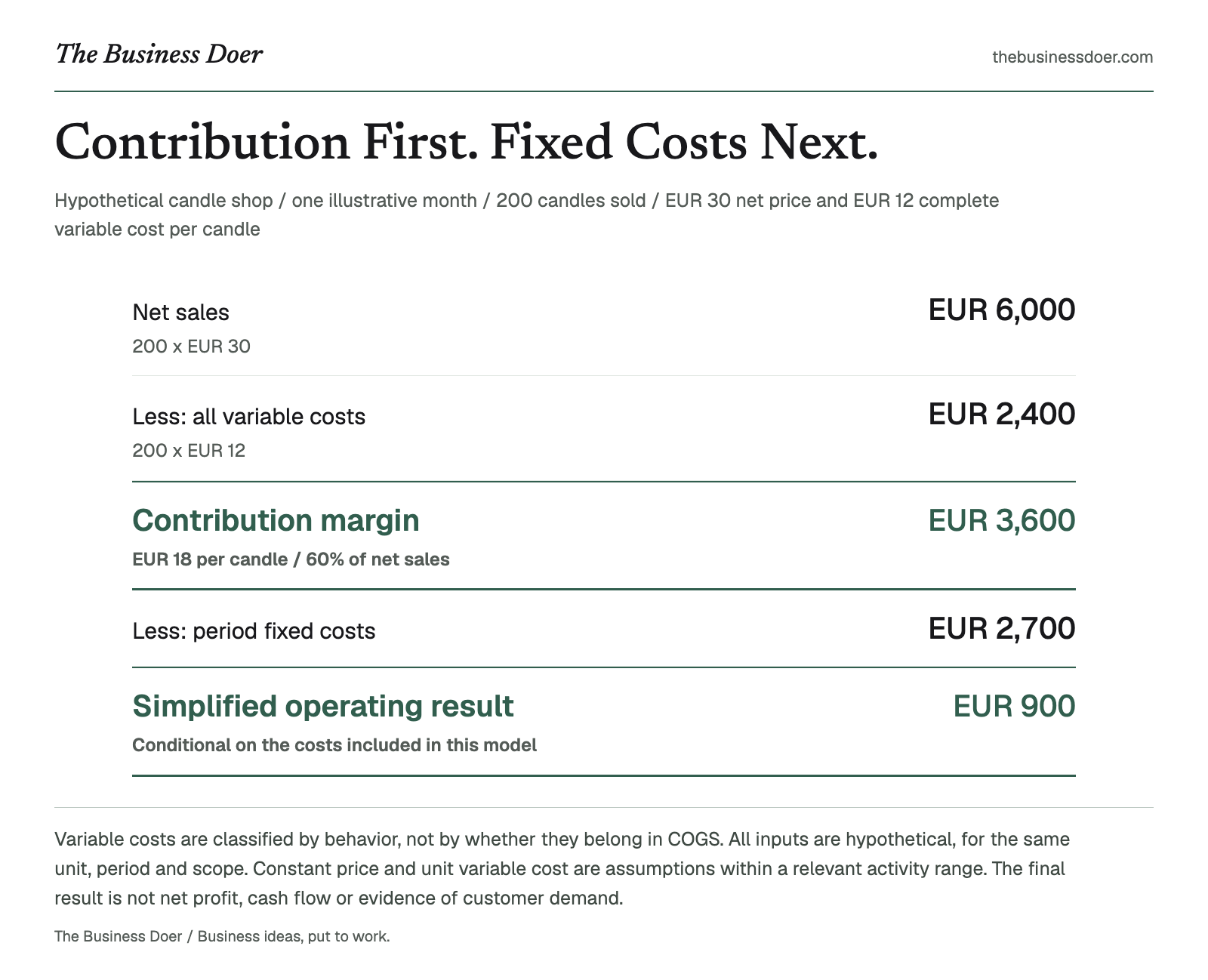
Text version
Hypothetical candle shop / one illustrative month / 200 candles sold / EUR 30 net price and EUR 12 complete variable cost per candle
- Net sales
- EUR 6,000. 200 x EUR 30
- Less: all variable costs
- EUR 2,400. 200 x EUR 12
- Contribution margin
- EUR 3,600. EUR 18 per candle / 60% of net sales
- Less: period fixed costs
- EUR 2,700
- Simplified operating result
- EUR 900. Conditional on the costs included in this model
Why does it matter?
Contribution margin helps you ask how much a sale contributes before fixed costs, whether total contribution covers the period's fixed costs, and how a price or variable-cost assumption affects the model. It supports pricing, unit economics and cost-volume-profit analysis.
It is mainly a managerial accounting measure for internal decisions. The calculation does not predict customer demand or prove that a price increase will lead to a better business outcome.
The formulas
There are three common expressions:
Total contribution margin = Total net sales - Total variable costs
Contribution margin per unit = Net selling price per unit - All variable cost per unit
Contribution margin ratio = Contribution margin / Net sales x 100
For one unit, divide unit contribution by unit net price. For a period, divide total contribution by total net sales. With one product, constant price and variable cost per unit, total contribution also equals unit contribution multiplied by units sold.
The unit ratio is undefined when unit price is zero. With a positive unit price it remains defined even when zero units are sold. The total ratio is undefined when total net sales are zero, including a period with no units sold; neither undefined case means 0%. Zero units produce zero total contribution in this model, but do not erase the period's fixed costs. A negative contribution is a valid result when variable costs exceed sales, not a calculation error to hide.
A simple example
Hypothetical example: A small candle shop models one month of a single candle product. Each candle sells for EUR 30 net, with EUR 12 of complete variable cost, including materials, packaging and a fee that varies with sales. Assume the same price and variable cost per unit throughout the relevant activity range.

Product, packaging and work all belong in the business picture. This scene is illustrative, not evidence of costs, margins or reduced damage.
| Item | Calculation | Result |
|---|---|---|
| Net selling price per candle | Given | EUR 30 |
| All variable cost per candle | Given | EUR 12 |
| Contribution margin per candle | EUR 30 - EUR 12 | EUR 18 |
| Unit contribution margin ratio | EUR 18 / EUR 30 x 100 | 60% |
| Candles sold during the month | Given | 200 |
| Total net sales | EUR 30 x 200 | EUR 6,000 |
| Total variable costs | EUR 12 x 200 | EUR 2,400 |
| Total contribution margin | EUR 6,000 - EUR 2,400 | EUR 3,600 |
| Total contribution margin ratio | EUR 3,600 / EUR 6,000 x 100 | 60% |
| Period fixed costs | Given | EUR 2,700 |
| Simplified model operating result | EUR 3,600 - EUR 2,700 | EUR 900 |
The 60% ratio means EUR 0.60 of each sales euro remains after variable costs, before fixed costs. The EUR 900 is a simplified model operating result only if the operating cost classification is complete and consistent, with no omitted or double-counted operating costs. It is not a cash-flow, VAT, tax or final-profit calculation.
When should you use it?
Use contribution margin to review pricing assumptions, consider a supplier or payment-fee change, examine sales volume, or compare the contribution of products with consistent cost definitions. It can also support a separate break-even analysis when unit contribution is positive and the model assumptions hold.
For the simple unit model, use one product, a constant net selling price and variable cost per unit, and fixed costs for a defined period within a relevant range. Revisit assumptions when capacity, discounts or cost behavior changes. A scenario is an assumption about volume, not evidence of actual demand.
How to interpret the result
Distinguish the amount from the ratio. EUR 20,000 of contribution tells you the money available before fixed costs. A 40% ratio tells you the share of net sales retained after variable costs. There is no universal good contribution margin: price, cost structure, sales volume and capacity all matter.
A product with high unit contribution may sell slowly. A lower-contribution product may generate more total contribution at a larger volume. Neither observation alone establishes which product to expand; scarce resources and demand also matter.
Positive contribution does not guarantee a positive operating result. With EUR 10,000 of contribution and EUR 12,000 of fixed costs, the simplified model has a EUR 2,000 operating loss. Negative unit contribution means each additional unit reduces total contribution under unchanged assumptions. Investigate the price, complete cost base and purpose of that sale before deciding what to change.
Common confusion
Contribution margin vs gross margin
Gross margin subtracts Cost of Goods Sold, or cost of sales, from net sales and expresses the remainder as a percentage. Contribution margin subtracts variable costs based on cost behavior.
The classifications are not interchangeable. A variable selling commission can reduce contribution without belonging in COGS. Fixed production overhead can enter inventory cost under absorption accounting but stays after contribution margin in a cost-behavior model. That is why gross profit and contribution margin can differ for the same business and period.
Contribution margin vs profit
Contribution margin comes before all fixed costs. Subtracting complete, consistently classified period fixed costs gives a simplified operating result, not final profit or cash available to spend. Use profitability analysis for a broader investigation of price, volume and costs.
Common mistakes
- Subtracting materials while omitting other variable costs.
- Treating every COGS cost as variable or every operating expense as fixed.
- Mixing units, periods, net and gross sales, or incomplete cost sources.
- Subtracting a fixed cost both before and after contribution margin.
- Assuming a positive contribution proves profitability.
- Treating a zero-sales ratio as 0% or suppressing a negative result.
- Using a blended ratio when product mix or capacity changes materially.
Limitations
Mixed costs, step costs and capacity limits require judgment and can invalidate a constant-cost model outside its relevant range. The calculation cannot classify costs or verify source records for you. Keep the evidence and assumptions alongside the numbers.
Contribution margin does not show cash timing, financing, tax or the complete economics of a business. Its usefulness depends on scope and classification, not on the precision of a displayed percentage.
Quick checklist
Review six points separately: scope and period; complete variable costs; fixed and mixed cost classification; the sign of unit contribution; coverage of period fixed costs; and the amount, ratio and zero-sales limits.
Put it to work in 20 minutes
Choose one product or service with a clear unit and net selling price.
- Define the unit and period - 2 minutes. Record whether one unit is a product, order, subscription month or booking, and state the analysis scope.
- Record net selling price - 2 minutes. Use a consistent price after discounts and returns, excluding VAT; record its source.
- Review all variable costs - 6 minutes. Include applicable materials, fees, commissions and variable fulfillment or labor. Record the aggregate per unit, the classification basis and the sources; separate supported mixed-cost components.
- Calculate unit contribution - 2 minutes. Subtract all variable cost per unit from net price. Retain a negative answer.
- Calculate the ratio - 2 minutes. Divide unit contribution by net price and multiply by 100; a zero price leaves the ratio undefined.
- Estimate total contribution - 3 minutes. Multiply unit contribution by a whole number of units sold or explicitly assumed for the period. Keep a scenario separate from observed sales.
- Compare with fixed costs - 3 minutes. Record complete period fixed costs, their classification and source. Subtract them only after contribution and review the assumptions before relying on the model result.
Finish with one question: Which price or variable-cost assumption most needs evidence before I act? Record the model's limits and the next evidence to collect.
A single-product model with constant net price and variable cost per unit. Currency changes relabel amounts; they do not convert them. Blank is not zero.
No documented model yet. Complete the amounts, scope, classification, evidence and review. A positive contribution alone does not establish profitability.
Review incomplete entries (11)
- price: Enter an amount; blank is not zero.
- variable: Enter an amount; blank is not zero.
- fixed: Enter an amount; blank is not zero.
- Enter 0 to 1,000,000,000 whole units, without separators. Blank is not zero.
- Confirm the period, complete cost classification and relevant-range assumptions.
- Record scope.
- Record unit.
- Record period.
- Record basis.
- Record evidence.
- Record question.
Key takeaways
- Contribution margin is net sales minus all variable costs for a consistent scope and period.
- It can be expressed in total, per unit or as a percentage with a nonzero sales denominator.
- All fixed costs come afterward; positive contribution alone does not prove profitability.
- Variable costs and COGS use different classifications.
- A single-product scenario needs constant assumptions within a relevant range and evidence for any decision.
Final takeaway
Contribution margin shows the remainder after variable costs and before fixed costs. Define the unit, period and complete cost base, preserve negative and undefined results, and check the evidence before turning a model into a decision.