Cross-Selling: What It Is and How It Works
A useful complement. An optional choice.
On this page
Cross-selling means offering a customer an additional product or service that complements something they are buying or have already bought. A shop might suggest a suitable pen to someone purchasing a notebook. The notebook remains the main purchase; the pen is an optional extra.
The aim is not simply to make the bill larger. A useful cross-sell helps the customer get more value from the original purchase while giving the business an opportunity to make an additional sale.
What is cross-selling?
Cross-selling is a sales technique built around a related need. Once a customer has chosen a product or service, the seller identifies something separate that could work well alongside it.
The second item does not have to be expensive. It might be a protective case for an electronic device, a cleaning service following a repair, or a carrying bag for a product that is difficult to transport.
A suggestion can happen before checkout, while a customer is buying, or after a purchase. It is still cross-selling if the recommendation is genuinely complementary and the customer can choose whether to accept it.

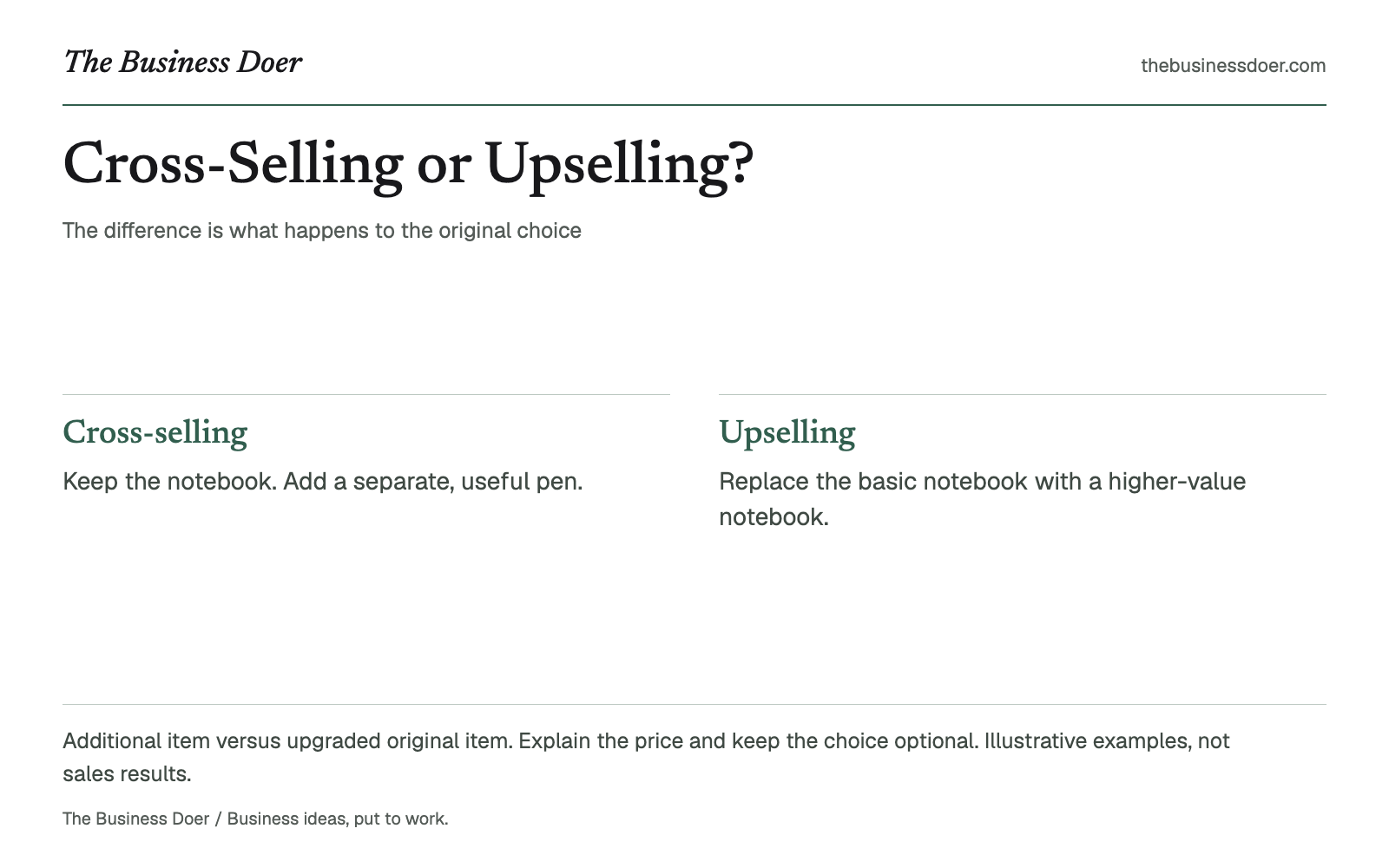
Visual reference. Additional item versus upgraded original item. Explain the price and keep the choice optional. Illustrative examples, not sales results.
Text version
The difference is what happens to the original choice
- Cross-selling
- Keep the notebook. Add a separate, useful pen.
- Upselling
- Replace the basic notebook with a higher-value notebook.
Why does it matter?
Good cross-selling can benefit both sides of a sale:
- Customers discover a useful item they may otherwise forget or overlook.
- Businesses have a chance to earn additional revenue from a relevant offer.
- Sales teams can serve a broader customer need without replacing the original product.
None of these outcomes is automatic. An irrelevant or poorly timed suggestion can confuse a buyer, create pressure, or even interrupt a purchase that was about to happen.
How does cross-selling work?
A straightforward approach is to start with the customer's actual purchase and ask four practical questions:
- What is the main product or service? Identify what the customer has selected or already uses.
- What else would genuinely help? Choose one relevant complement, not a random product the business wants to move.
- Is the timing appropriate? Offer it when the customer can understand its purpose and price without disrupting the main decision.
- Can the customer decline easily? Make the extra optional and explain its value plainly.
The 4Ps of marketing can help align the complement's usefulness, separate price, availability and message.
For a small shop, this might mean one sentence from a salesperson. Online, it could be a clearly labelled add-on next to the item in a basket. A service business might raise the option during a follow-up conversation.
Cross-selling is about the relevance of the additional offer, not about the channel used to present it.
A simple example
Hypothetical example: A small stationery shop sells notebooks for EUR 12 each. It offers a compatible pen for EUR 3 to customers buying a notebook.

AI-generated illustrative photograph of a notebook and a separate pen. It does not document the hypothetical shop, customer choices or measured sales.
Over one week, 40 customers each buy one notebook. Ten of them also choose one pen.
| Item | Quantity sold | Unit price | Sales revenue |
|---|---|---|---|
| Notebook | 40 | EUR 12 | EUR 480 |
| Optional pen | 10 | EUR 3 | EUR 30 |
| Total | EUR 510 |
The add-on generated EUR 30 in pen sales. Ten of the 40 notebook buyers accepted the offer, an acceptance rate of 25% in this small example.
This does not mean the shop earned EUR 30 in additional profit. Pens have costs, and some customers might have bought one without the suggestion. The example shows what was sold, not the exact incremental profit caused by the offer.
When should you use cross-selling?
Consider it when there is a clear relationship between the primary purchase and the extra item. A compatible accessory may be relevant at checkout. An additional service may make more sense after the customer has used the original service and identified another need.
Keep the suggestion proportionate to the purchase. Someone making a simple purchase should not have to examine a long list of unrelated extras. And if the buyer says no, the original transaction should remain straightforward.
For a service business, a sales pipeline can track a separate, genuinely relevant follow-up opportunity. It is not a reason to treat every existing customer as a new lead.
For customer follow-ups, use an appropriate and permitted contact method. A completed purchase is not, by itself, permission to send unrestricted promotional messages.
How should you interpret the result?
If you test a cross-sell, record how many eligible customers saw the offer, how many accepted it, and the revenue and costs of the additional items. Use the same definitions each time.
A higher acceptance rate can be encouraging, but it does not prove the approach is beneficial. Also check whether the suggestion disrupts the original sale, creates returns or complaints, or fails to cover its costs. There is no single acceptance rate that is good for every product or business. For contract-based sales, average deal size can describe completed deal values; it is not the same as an order-level add-on acceptance rate.
Cross-selling vs. upselling
These terms describe different recommendations:
- Cross-selling: Add a complementary product. A customer buys a notebook and adds a pen.
- Upselling: Offer a higher-value version of the original choice. A customer considers a basic notebook and chooses a premium notebook instead.
The distinction is an additional item versus an upgraded original item. Both techniques should begin with the customer's needs rather than the seller's desire to increase spending.
Common mistakes
- Suggesting unrelated products. A popular add-on is not useful if it does not fit the customer's purchase.
- Presenting too many options. A wall of suggestions can make a simple purchase harder.
- Hiding the extra price. Customers should know they are agreeing to an additional charge.
- Treating extra revenue as extra profit. Consider the cost of supplying the add-on and any effect on the main sale.
- Pressuring the customer. A helpful recommendation should be easy to refuse.
Limitations
Cross-selling works only when a relevant additional need exists. Some customers already own the accessory; others have a strict budget or simply do not want extras. An offer that improves one buyer's experience may annoy another. Results should therefore be tested and assessed rather than assumed.
Quick checklist
- Is the suggested item genuinely useful alongside the main purchase?
- Can I explain the connection in one clear sentence?
- Is the price visible and the choice optional?
- Is this a sensible moment to make the suggestion?
- Can I measure sales and costs without confusing the two?
Put it to work: suggest one useful add-on
In 15 minutes, choose a product or service your business sells. Write a realistic customer use case and identify one compatible, separately priced complement. Draft a one-sentence, optional suggestion that explains why the extra is useful.
Decide what to measure in a small test: eligible customers shown the offer, acceptances, added revenue, added cost and signs the main purchase was disrupted. If you cannot explain a genuine benefit, choose a different complement or do not suggest one.
Final takeaway
Cross-selling is a simple idea: recommend a useful complement to something the customer already wants. It can improve the usefulness of a purchase and create extra sales, but only when the recommendation fits the customer's needs and remains optional.
Start with one relevant pairing, explain it clearly, and observe what customers actually choose. A smaller, helpful suggestion is often better than a longer list of unrelated products.