RACI Matrix: What It Is and How to Use It
Make ownership explicit. Keep communication intentional.
On this page
A RACI matrix is a table that shows who is involved in each important project activity. RACI stands for Responsible, Accountable, Consulted and Informed. It distinguishes the person doing the work from the person answerable for its outcome, while identifying who should give input and who needs updates.
A small table and a team discussion are often enough. The value comes from agreeing on the assignments, not simply filling in letters.
What is a RACI matrix?
A RACI matrix, also called a RACI chart or responsibility assignment matrix, lists activities in rows and people or roles in columns. Each intersection shows that role's participation, if any.
Its purpose is role clarity, not tracking deadlines or deciding how to perform the task. A project plan describes what must happen and when. RACI makes clear who plays which part.

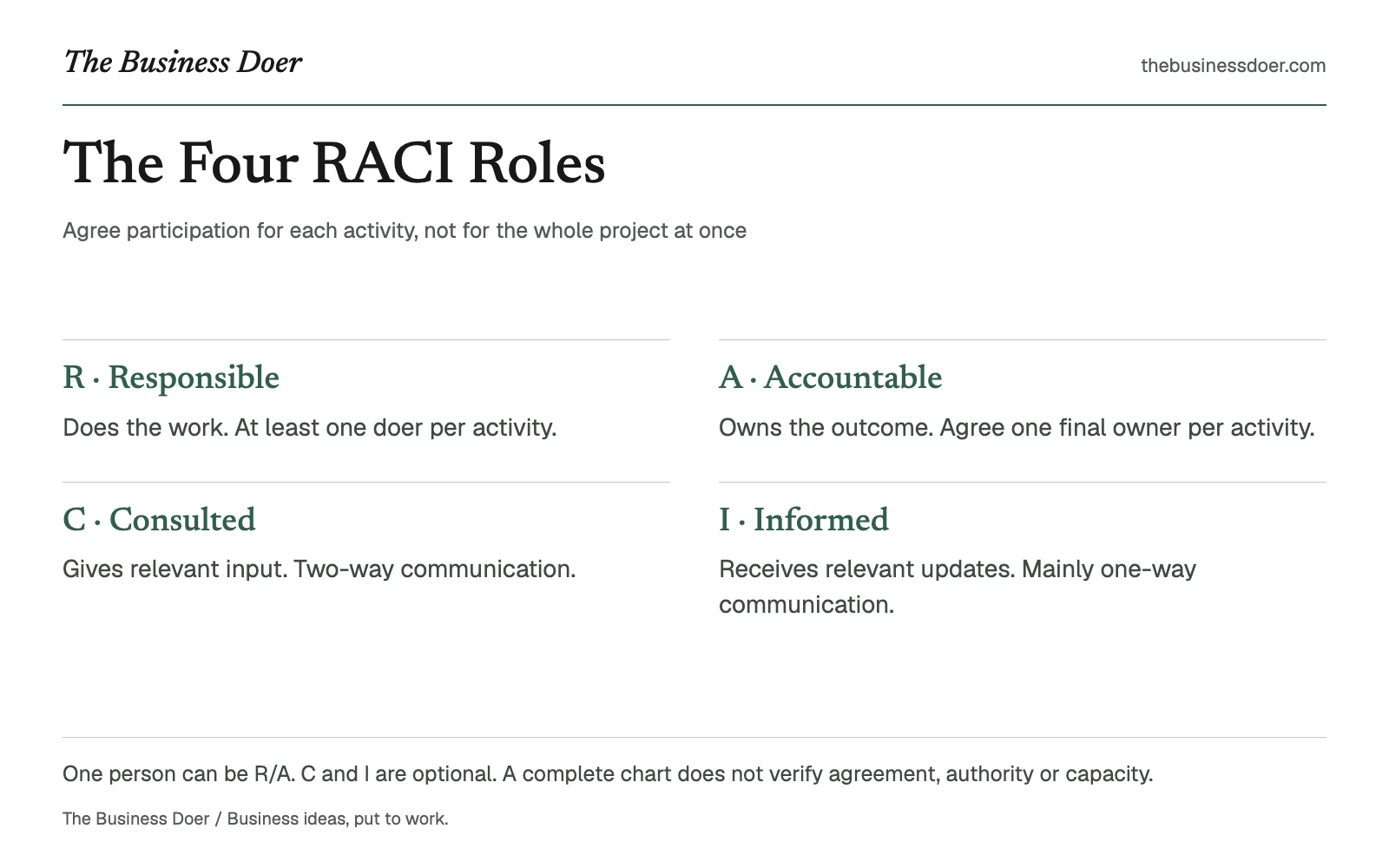
Visual reference. One person can be R/A. C and I are optional. A complete chart does not verify agreement, authority or capacity.
Text version
Agree participation for each activity, not for the whole project at once
- R · Responsible
- Does the work. At least one doer per activity.
- A · Accountable
- Owns the outcome. Agree one final owner per activity.
- C · Consulted
- Gives relevant input. Two-way communication.
- I · Informed
- Receives relevant updates. Mainly one-way communication.
Why does it matter?
Work can fall between roles: two teammates may assume the other will complete a task, or everyone may wait for approval that nobody owns. A RACI discussion can expose those gaps before work begins.
It can also distinguish consultation from notification. Someone who needs a final update does not necessarily need to approve every intermediate decision. The chart is useful only if the people involved understand and accept it.
What do R, A, C and I mean?
| Letter | Role | Participation |
|---|---|---|
| R — Responsible | Does the work | Carries out the activity. More than one person may be R when necessary. |
| A — Accountable | Owns the outcome | Has final ownership and the authority to accept completion. Agree on one A per activity. |
| C — Consulted | Gives input | Provides relevant expertise or feedback before the work or decision is finalized. Communication is two-way. |
| I — Informed | Receives updates | Needs progress or outcome information without necessarily participating in the work. Communication is mainly one-way. |
One person can be both R and A on a small task: write R/A in that cell. Not every activity needs a C or I. A blank cell means no assigned participation, not missing data that must be filled with a letter.
Start with a doer and a single accountable owner. If your governance requires several separate approvals, clarify those decisions or split the deliverable into appropriate activities rather than hiding conflicting authority in one row.
A simple RACI example
Hypothetical example: A neighborhood bakery is adding online pre-orders for collection at the counter. Four roles contribute: Owner, Operations Lead, Web Freelancer and Counter Team. The assignments below are a proposal, not an observed or agreed operating arrangement.

A neighborhood bakery is a concrete setting for discussing capabilities, growth choices and economics. No business performance is implied by this image.
| Activity | Owner | Operations Lead | Web Freelancer | Counter Team |
|---|---|---|---|---|
| Define collection rules | A | R | I | C |
| Build the order form | I | A | R | C |
| Test collection at the counter | I | A | C | R |
| Prepare and approve the launch | A | R | C | I |
For the order form, the Web Freelancer is R: they build it. The Operations Lead is A: they own acceptance against the agreed requirements. The Counter Team is C because it understands how orders will be handled. The Owner is I rather than an approver of each design choice.
This works only if the Operations Lead actually has that authority. If the Owner retains final sign-off, agree on a revised row before work starts. The photograph is illustrative; it does not document the launch or confirm anyone's authority.
How to create a RACI matrix
- Choose a scope. Map one project or defined process, not the entire business.
- List activities. Give each meaningful task or deliverable its own row.
- Add roles. Role names can remain useful when the people holding them change.
- Assign R and A first. Identify who performs the activity and one role that owns its result.
- Add useful C and I assignments. Consult people whose input matters; inform people who need the outcome or progress.
- Review together. Confirm authority and capacity with the participants, share the agreed chart and name its maintainer and review trigger.
When should you use it?
Use RACI at the start of a cross-functional project, during a handoff or when responsibilities are unclear. A growing business may find it useful when informal coordination no longer makes ownership obvious.
A straightforward two-person task may not need a formal chart. Use it when the clarity is worth maintaining. A SIPOC diagram can establish the high-level process and boundaries before you assign roles.
How to interpret the completed chart
Read across each row. No R means there is no designated doer. No A means there is no clear outcome owner. More than one A calls for an explicit agreement about who accepts the result.
Then read down each column. If one role is A on almost every activity, discuss actual capacity and authority. If everyone is C everywhere, question whether each consultation changes the work. Multiple R assignments are allowed, but those participants still need clear coordination.
These are discussion prompts, not workload scores. A count of assignments does not measure task duration, complexity, staffing or how well a team is organized.
Responsible versus Accountable
In everyday English the words can overlap. Here they answer different questions: R does the work; A ultimately owns its result. One person can do both. An accountable lead can accept work performed by others.
The chart does not itself change legal authority, job descriptions or reporting lines. It cannot resolve a dispute by assigning a letter.
Common mistakes
- Giving several roles final ownership without agreeing how decisions work.
- Leaving an activity without anyone assigned to do it.
- Consulting everybody on everything.
- Using a matrix instead of deadlines, milestones or instructions.
- Treating a structurally complete table as proof of team agreement.
- Leaving an old chart in place after roles or scope change.
Limitations
RACI clarifies participation; it does not create authority or spare capacity. Teams still need expectations, resources, deadlines and a way to resolve disagreements. A standard operating procedure documents how recurring work is done; RACI clarifies participation in that work.
For process improvement, use the PDCA cycle to plan, test, review and act on evidence. Clear ownership supports those steps but does not establish that a change worked.
Quick checklist
Put it to work in 20 minutes
Choose a small project with four or five activities and three or four roles.
- Minutes 0–5: Define the scope and list the meaningful activities.
- Minutes 5–10: Assign the doers and one accountable role per activity.
- Minutes 10–15: Add genuinely useful consultation and updates.
- Minutes 15–20: Discuss gaps, authority and capacity with participants. Name the chart maintainer and a review trigger.
The worksheet checks structure, not whether a team actually agrees. Keep unresolved questions in the discussion notes. A complete example still requires a fresh team-review confirmation before download. No notification is sent to the roles you enter.
Team roles
R: does the work. A: owns the outcome. C: gives input. I: receives updates. R/A combines R and A. Unassigned cells stay blank.
| Activity | Role 1 | Role 2 | Role 3 | Role 4 | Remove activity |
|---|---|---|---|---|---|
| 0 R / 0 A | |||||
| 0 R / 0 A | |||||
| 0 R / 0 A | |||||
| 0 R / 0 A |
Structural check only. Multiple R assignments are allowed; C and I are optional.
Review open items (18)
- Name the project or process.
- Name the chart maintainer.
- Record a review trigger or date.
- Name every role.
- Give each role a unique name.
- Give each activity a unique name.
- Activity 1: name the activity.
- Activity 1: assign at least one R.
- Activity 1: assign exactly one A.
- Activity 2: name the activity.
- Activity 2: assign at least one R.
- Activity 2: assign exactly one A.
- Activity 3: name the activity.
- Activity 3: assign at least one R.
- Activity 3: assign exactly one A.
- Activity 4: name the activity.
- Activity 4: assign at least one R.
- Activity 4: assign exactly one A.
Review assignments by role
- : R 0; A 0; C 0; I 0
- : R 0; A 0; C 0; I 0
- : R 0; A 0; C 0; I 0
- : R 0; A 0; C 0; I 0
Counts are discussion prompts, not workload scores. One A on every row is a reason to discuss capacity, not proof of overload.
Key takeaways
- RACI separates doing, outcome ownership, advice and updates.
- R/A lets one person both perform and own an activity.
- Start with R and one A, then add C and I where useful.
- Row and column reviews identify questions, not automatic judgments about capacity.
- Agreement and maintenance matter more than filling every cell.
Final takeaway
RACI answers a practical question: Who does what, and who owns the result? Keep the scope small, agree the assignments with the people involved and update the chart when the project changes. The most useful chart is the one the team understands and can use.