Scenario Planning: What It Is and How to Use It
One decision. Several plausible futures.
On this page
Scenario planning is a method for exploring several plausible versions of the future and asking how a business would respond to each one. Rather than predicting a single outcome, it helps people make decisions that can hold up under different conditions.
A business cannot know exactly how customer habits, costs or regulation will change. It can still prepare. Scenario planning turns uncertainty into a structured conversation about choices made today.
What is scenario planning?
Scenario planning is a strategic framework for describing different ways the external environment could develop over a chosen period. Each scenario is a coherent picture of possible conditions, not a forecast or a promise.
The method is especially useful when a major decision depends on changes the business does not control. Its purpose is not to identify the one future that will happen. It is to reveal which assumptions matter and which decisions remain sensible if those assumptions change.

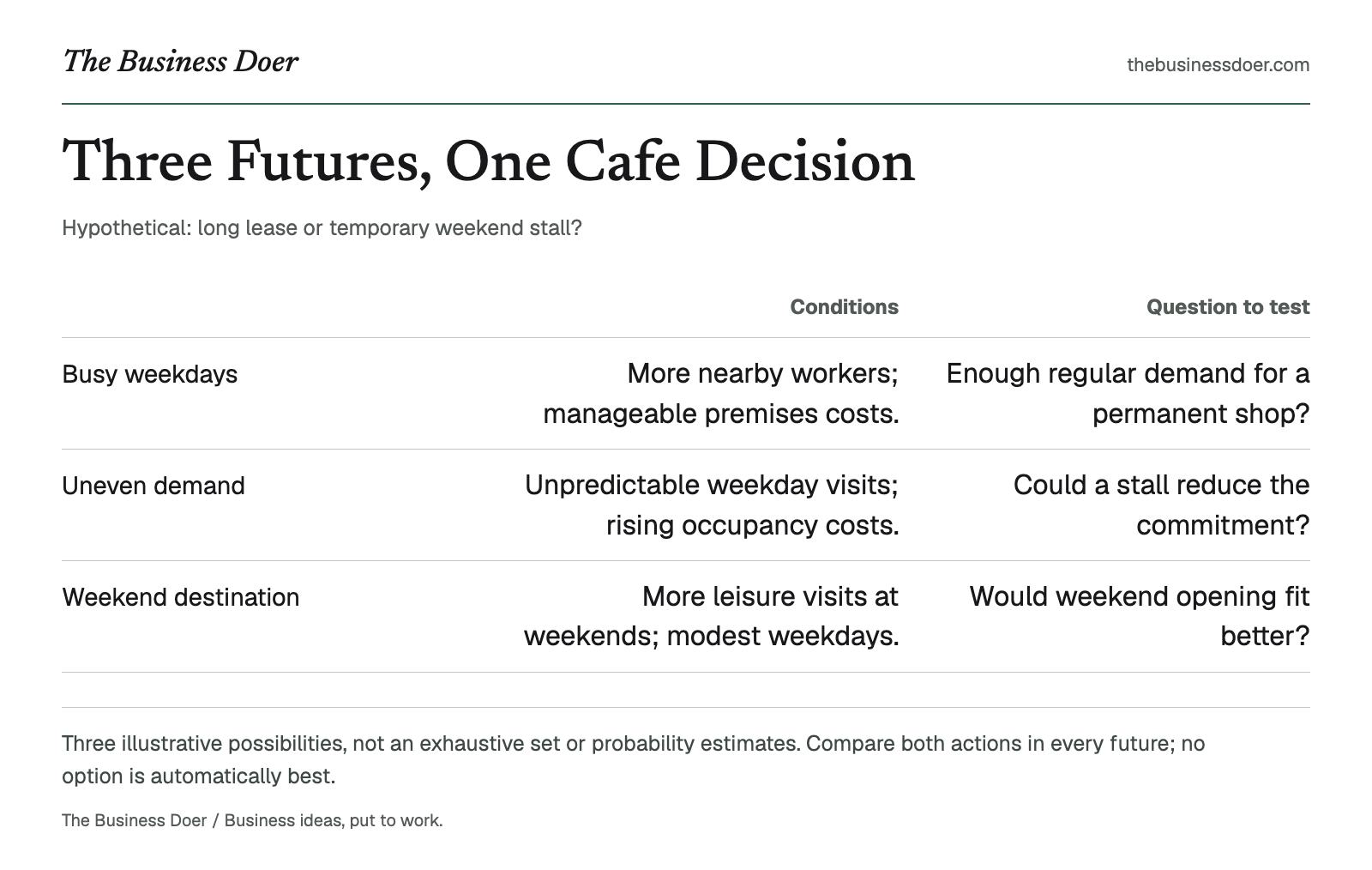
Visual reference. Three illustrative possibilities, not an exhaustive set or probability estimates. Compare both actions in every future; no option is automatically best.
Text version
Hypothetical: long lease or temporary weekend stall?
- Busy weekdays
- Conditions: More nearby workers; manageable premises costs.; Question to test: Enough regular demand for a permanent shop?
- Uneven demand
- Conditions: Unpredictable weekday visits; rising occupancy costs.; Question to test: Could a stall reduce the commitment?
- Weekend destination
- Conditions: More leisure visits at weekends; modest weekdays.; Question to test: Would weekend opening fit better?
Why does it matter?
Planning around just one expected future can hide important risks. If a small company assumes demand will keep growing, it may sign an expensive lease without asking what would happen if buying habits shift.
Scenario planning helps teams question those assumptions. It can reveal options that work under several futures, expose commitments that are difficult to reverse and show which changes deserve attention. The value comes from better preparation, not greater certainty.
How does scenario planning work?
A basic scenario exercise has five steps. These are a practical starting sequence, not a mandatory formula.
1. Define the decision and time horizon. Ask a specific question such as, “Should we open a second shop within the next three years?” A clear decision keeps the exercise useful.
2. Identify the main drivers. List factors that could influence the decision: customer demand, costs, competitors, regulations or working patterns. Separate relatively established trends from genuinely uncertain developments. An external-environment review such as PESTEL analysis can help organize this research.
3. Describe two to four plausible futures. Combine important uncertainties into distinct, internally consistent scenarios. Give each scenario a short name and explain what daily business conditions would look like. Do not label them merely “good,” “average” and “bad.”
4. Test the decision in each future. Ask what could succeed, what could fail and which commitments would be hard to change. Compare alternatives against every scenario, rather than picking a favourite story.
5. Decide what to do and what to watch. Identify useful actions today and a few observable signs that suggest conditions are moving in one direction. Revisit the scenarios when important assumptions change.
A simple hypothetical example
Hypothetical example: A neighbourhood café is considering a second location. It wants to decide whether to sign a long lease or first test demand with a temporary weekend stall.

Illustrative cafe scene generated with AI. It does not depict the hypothetical business or establish future traffic, costs or demand.
The owners identify two uncertainties: how local customer traffic might change and whether occupancy costs will rise. They describe three possible futures:
| Possible future | What conditions look like | Question for the café |
|---|---|---|
| Busy weekdays | More people work nearby and premises costs remain manageable. | Would a permanent shop capture enough regular demand? |
| Uneven demand | Weekday visits stay unpredictable while premises costs increase. | Could a temporary stall limit exposure? |
| Weekend destination | More customers visit for leisure on weekends, but weekday demand stays modest. | Would weekend opening be more suitable than a full-time lease? |
These are invented possibilities, not market research or probability estimates. The exercise does not prove that a stall is the best option. It shows why the owners should test weekday and weekend demand before making a hard-to-reverse commitment.
When should you use it?
Scenario planning is useful for decisions with a long lifespan and meaningful external uncertainty: entering a new market, expanding premises, making a large investment or developing a multi-year strategy.
It is less useful for routine decisions with reliable short-term information. A weekly stock order may be better handled with a normal demand forecast. Choose the method that fits the decision.
How should you interpret the result?
A scenario is not a score, target or probability. Read the scenarios together and ask: Which option remains acceptable across different conditions? Which choice succeeds only if one assumption proves true?
A choice that works reasonably well in several scenarios may be more resilient than one that performs brilliantly in only one. That does not make it automatically superior: costs, opportunities and available resources still matter. The VRIO framework can help examine whether a resource gives the business an advantage in the conditions being considered.
Common confusion: scenarios versus forecasts
A forecast estimates what is expected to happen, usually using available information and assumptions. A scenario describes what could happen under a distinct set of plausible assumptions. A forecast can inform a plan; scenarios help test whether the plan can withstand a wider range of conditions.
Scenario planning is also not a business plan. It informs strategic choices, but does not replace budgets, customer research or feasibility checks.
Common mistakes
- Writing one preferred future. That is a plan or expectation, not a useful comparison of alternatives.
- Calling scenarios predictions. Plausibility does not mean that an outcome is likely.
- Using only best-case and worst-case stories. This can overlook different kinds of change, including mixed outcomes.
- Ignoring the decision. Interesting future stories are not enough; each must help test a real choice.
- Never revisiting assumptions. Early warning signs matter only if someone reviews them and responds.
Limitations
Scenario planning depends on the quality and diversity of its assumptions. Teams can miss important developments, create implausible stories or favour outcomes they already believe in. It does not calculate market size, investment returns or the probability of each future. For consequential decisions, use it alongside evidence and financial analysis.
Quick checklist
- Is there one specific decision and a clear time horizon?
- Have we identified important external uncertainties?
- Are the scenarios different, coherent and plausible?
- Have we tested the same decision against each scenario?
- Have we identified practical actions and signs to monitor?
Put it to work: a 25-minute scenario check
- Minutes 0–5: Write one real decision and its time horizon in a sentence.
- Minutes 5–10: List five external drivers; select the two that are both important and uncertain.
- Minutes 10–17: Write three short, distinct and plausible futures, each with two or three conditions.
- Minutes 17–22: Compare the same two possible actions under all three futures. Record one vulnerability for each action in each future.
- Minutes 22–25: Identify one action worth taking now and one observable sign that would trigger a review.
Output: One decision, three scenario descriptions, a short comparison and one review trigger. This is a first-pass exercise, not a substitute for a full strategic assessment.
Two actions to compare
For every action, record what could work and one vulnerability in each future. No score or winning option is calculated.
Final takeaway
Scenario planning does not tell a business what the future will be. It helps the business prepare for several ways the future might unfold. Start with one decision, write a few plausible scenarios and ask how your options perform in each. The goal is a better decision today, not a perfect prediction tomorrow.