Kano Model: How to Classify Product Features by Customer Satisfaction
Not every feature creates satisfaction in the same way.
On this page
The Kano Model is a framework for classifying product or service features according to how their presence or absence affects customer satisfaction. Instead of assuming that every feature creates value in the same way, it separates basic expectations from performance features, potential delighters and features customers may not care about.
It is useful when a team has several possible improvements but needs to understand what customers actually expect before deciding what belongs in a product.
What is the Kano Model?
The Kano Model was introduced by Noriaki Kano and colleagues in 1984 to describe different relationships between product quality and customer satisfaction.
Its central idea is simple: satisfaction is not always proportional to how much of a feature you provide. Some features are expected and mainly cause dissatisfaction when missing. Others create more satisfaction as performance improves. A third group can pleasantly surprise customers even though customers may not expect them.
The model is normally applied by asking customers paired questions about each feature: how they feel if the feature is present and how they feel if it is absent. The answers are then used to classify that feature. The visual below summarizes the relationships, not measured customer results or a priority ranking.

Visual reference. Use actual paired customer responses, not internal predictions. Classifications can differ by segment and change over time. Questionable answer pairs require investigation; they are not a sixth feature priority.
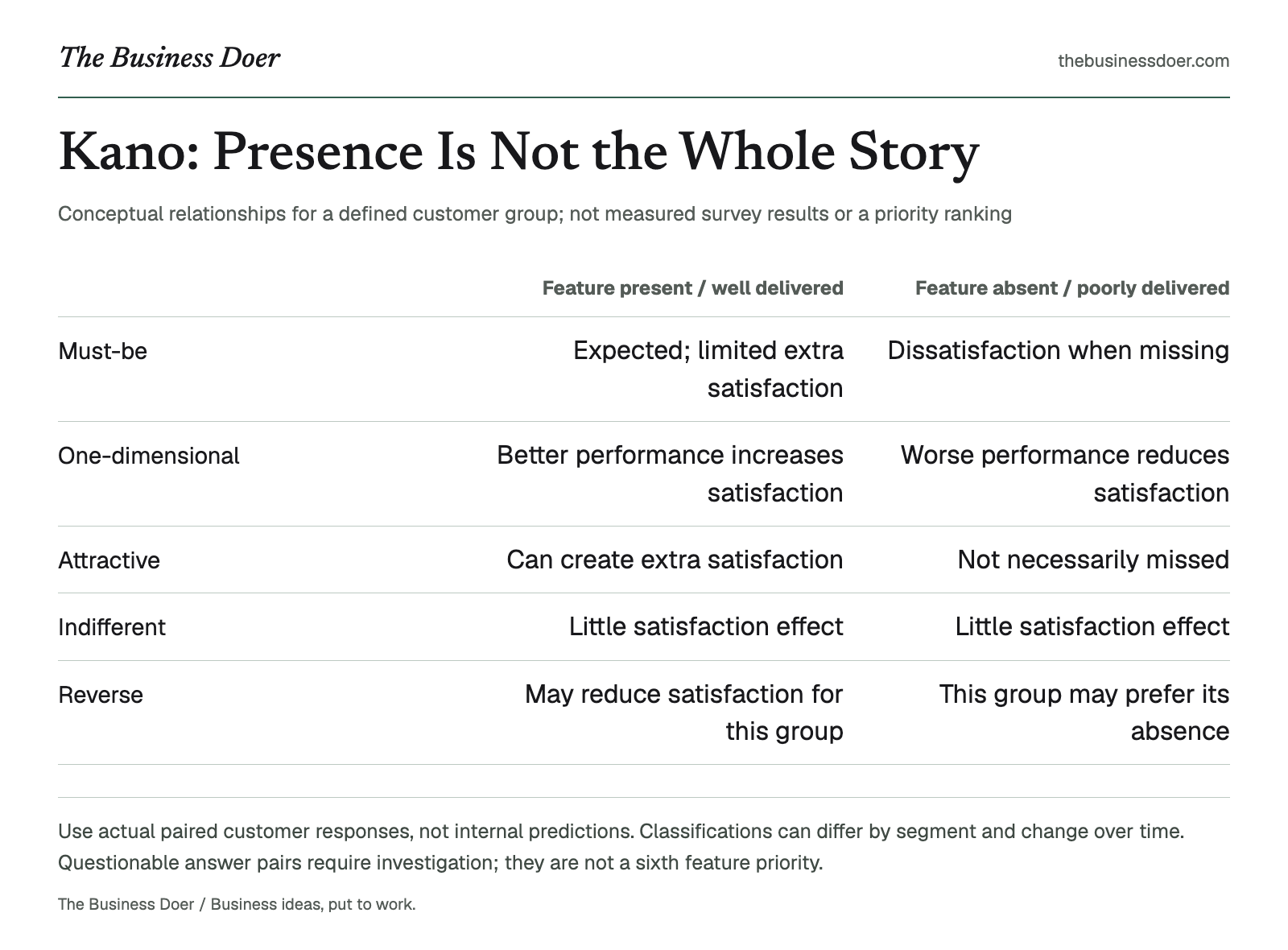
Text version
Conceptual relationships for a defined customer group; not measured survey results or a priority ranking
- Must-be
- Feature present / well delivered: Expected; limited extra satisfaction; Feature absent / poorly delivered: Dissatisfaction when missing
- One-dimensional
- Feature present / well delivered: Better performance increases satisfaction; Feature absent / poorly delivered: Worse performance reduces satisfaction
- Attractive
- Feature present / well delivered: Can create extra satisfaction; Feature absent / poorly delivered: Not necessarily missed
- Indifferent
- Feature present / well delivered: Little satisfaction effect; Feature absent / poorly delivered: Little satisfaction effect
- Reverse
- Feature present / well delivered: May reduce satisfaction for this group; Feature absent / poorly delivered: This group may prefer its absence
Why does it matter?
Without this distinction, teams can treat every requested feature as equally important. That can lead to spending time on improvements customers barely notice while missing basic expectations that cause frustration.
The Kano Model clarifies the role a feature plays in the customer experience. It can support product discovery, prioritization and Product Roadmap discussions, but it does not replace business judgment.
The five main categories
Must-be
Must-be features are basic expectations. Customers may not praise a product for having them, but they can become dissatisfied when they are missing or poorly delivered.
One-dimensional
One-dimensional features have a more direct relationship between performance and satisfaction. Better performance generally increases satisfaction, while worse performance decreases it.
Attractive
Attractive features can create extra satisfaction when present without necessarily causing dissatisfaction when absent. They are often described as delighters.
Indifferent
Indifferent features have little effect on satisfaction whether they are present or absent. That does not automatically mean they should be removed: a feature can still matter for legal, operational or strategic reasons.
Reverse
Reverse features are features where some customers may prefer the opposite of what is being proposed. Adding more of the feature can reduce satisfaction for that group. Investigate the preference and segment rather than assuming every customer wants the same experience.
A survey can also produce a questionable response when the paired answers are inconsistent. That is normally treated as a response or wording problem to investigate, not a sixth feature category to prioritize.
How the paired questions work
Describe one specific feature, then ask a functional question about its presence and a dysfunctional question about its absence. Use the same response options for both questions: liking it, expecting it, being neutral, tolerating it or disliking it.
Apply a documented Kano evaluation table consistently to each customer's answer pair. Do not infer a category from a single answer, average the response-option positions as a satisfaction score, or replace customer answers with the team's predictions. Review the distribution of classifications, unclear answers and differences between segments before summarizing a feature.
A simple example
Hypothetical example: Imagine an appointment-booking service used by customers of a small hair studio. The following classifications illustrate the model; no actual customers were surveyed and no counts or measured preferences are claimed.
| Feature | Illustrative classification | What the relationship means |
|---|---|---|
| Reliable booking confirmation | Must-be | Expected; failures cause frustration. |
| Shorter booking time | One-dimensional | Easier, faster booking can increase satisfaction. |
| One-tap rescheduling | Attractive | Appreciated when available, without necessarily being expected. |
| Decorative profile themes | Indifferent | Little difference to the booking experience for this imagined group. |
In a real study, any of these could receive a different classification. One-tap rescheduling may already be expected by some customer groups. Reverse preferences are also possible; investigate them rather than assigning a universal category to the feature.

A fictional hair-studio booking moment illustrates the service context. This scene is not a survey, a real app interface or evidence of customer satisfaction.
The output is not a single score. It is a clearer view of how different features influence satisfaction for the customers and context studied.
When should you use it?
Use the Kano Model when you have a defined customer group and a manageable set of features or requirements to evaluate. It is particularly useful before a roadmap or prioritization decision, when a team wants to distinguish basic expectations from competitive performance and possible delight.
It is less useful when feature ideas are vague, the customer segment is unclear or the team lacks meaningful customer feedback. Design Thinking can help explore customer needs and frame clearer ideas before surveying them. Jobs to Be Done and the Value Proposition Canvas are also related ways to investigate needs; Kano answers the narrower question about satisfaction with a defined feature.
How to interpret the result
Treat the categories as evidence about customer expectations, not as an automatic ranking system.
Must-be features usually need an acceptable baseline because failures can create dissatisfaction. One-dimensional features are areas where better performance may help a product compete. Attractive features may create differentiation when they fit the product strategy. Indifferent features deserve scrutiny before more resources are invested. Reverse results may indicate that different customer segments want different experiences.
Teams should still consider cost, effort, risk, strategic fit and technical dependencies before deciding what to build. A Minimum Viable Product can test a defined behavioral assumption; stated enthusiasm in a Kano survey alone does not prove payment or continued use.
Common confusion
The Kano Model is often confused with a general feature-prioritization score. It does not calculate which feature gives the highest business return, and it does not directly compare effort with impact.
It is better understood as a customer-satisfaction classification framework. Its output can inform another decision method, such as RICE Prioritization, but Kano categories are not a complete roadmap by themselves.
Common mistakes
- Classifying features internally instead of surveying customers. The model is intended to reflect customer responses, not team assumptions.
- Treating a category as permanent. Expectations can change as markets and habits evolve.
- Surveying features that are too vague. Customers need to understand what is being evaluated.
- Assuming every attractive feature should be built. Delight does not automatically justify the cost.
- Ignoring customer segments. The same feature may be classified differently by different groups.
Limitations
The Kano Model does not measure development cost, revenue impact, technical complexity or strategic importance. Results also depend on the customers surveyed and the wording of the questions. Features can move from attractive to expected over time, so classifications should be revisited.
A completed questionnaire is only a research plan. It is not customer evidence, a completed Kano analysis or approval to build a feature.
Quick checklist
Put it to work: a 25-minute Kano survey setup
Choose one defined customer segment and four feature ideas you are considering.
- Describe each feature precisely enough that a customer can understand it without explanation. Avoid combining several ideas.
- Write one functional question about having the feature and one dysfunctional question about not having it. Keep the response options consistent.
- If useful, record the team's expected category, explicitly as a hypothesis, not a result. Unknown is acceptable. Keep these predictions out of the customer questionnaire.
- Record how you will recruit real customers and pilot the wording; do not select only supportive respondents.
- Set a response-review point and name the Kano evaluation method you will use after collecting actual paired answers.
- Rewrite any vague, leading or bundled feature before sending the survey.
The exercise is complete when you have a clean four-feature questionnaire and a research plan. Keep internal predictions separate from the questions customers receive, and do not convert those predictions into Kano results.
Hypotheses stay out of the customer questionnaire. Check that each pair evaluates the same single feature, without leading wording.
Feature 1: not drafted
- Feature present
- Question not drafted.
- Feature absent
- Question not drafted.
Feature 2: not drafted
- Feature present
- Question not drafted.
- Feature absent
- Question not drafted.
Feature 3: not drafted
- Feature present
- Question not drafted.
- Feature absent
- Question not drafted.
Feature 4: not drafted
- Feature present
- Question not drafted.
- Feature absent
- Question not drafted.
Before downloading (18 checks)
- Customer segment: add the missing context.
- Service context: add the missing context.
- Recruitment approach: add the missing context.
- Review point: add the missing context.
- Analysis plan: add the missing context.
- Feature 1: add a description.
- Feature 1: add a functional question.
- Feature 1: add a dysfunctional question.
- Feature 2: add a description.
- Feature 2: add a functional question.
- Feature 2: add a dysfunctional question.
- Feature 3: add a description.
- Feature 3: add a functional question.
- Feature 3: add a dysfunctional question.
- Feature 4: add a description.
- Feature 4: add a functional question.
- Feature 4: add a dysfunctional question.
- Confirm the segment, feature descriptions and paired questions have been checked for clear, neutral wording.
Key takeaways
- The Kano Model classifies features by how their presence or absence affects customer satisfaction.
- The five main categories are must-be, one-dimensional, attractive, indifferent and reverse.
- A classification should come from customer responses to paired questions, not internal opinion.
- Kano does not calculate business value, development effort or final roadmap priority.
- Classifications can change over time and differ between customer segments.
Final takeaway
The Kano Model helps explain why different features affect customer satisfaction in different ways. Some prevent dissatisfaction, some improve satisfaction as performance rises, and some can create unexpected delight.
Its value is not in producing a perfect priority list. It helps teams understand what customers expect before deciding where product effort should go.