Marketing Funnel: What It Is and How It Works
From first awareness to the relationship after conversion.
On this page
A marketing funnel is a simple model of how people move from first discovering a problem or brand to taking a desired action and, ideally, becoming repeat customers or advocates. It helps a business organize marketing around different levels of customer readiness.
The funnel is wider at the top because many people may become aware, while fewer continue to each later stage. It is a planning model, not a claim that every customer follows one straight path.
What is a marketing funnel?
A marketing funnel divides the customer journey into stages. Each stage represents a different question in the potential customer's mind and therefore requires a different marketing goal.
Stage names vary between organizations. A beginner-friendly version uses four:
- Awareness
- Consideration
- Conversion
- Retention and advocacy
The model connects these stages so a business can plan messages, offers, channels and measurements as one system. Retention and advocacy describe related post-conversion behaviors, not a requirement that someone must return before recommending the business.

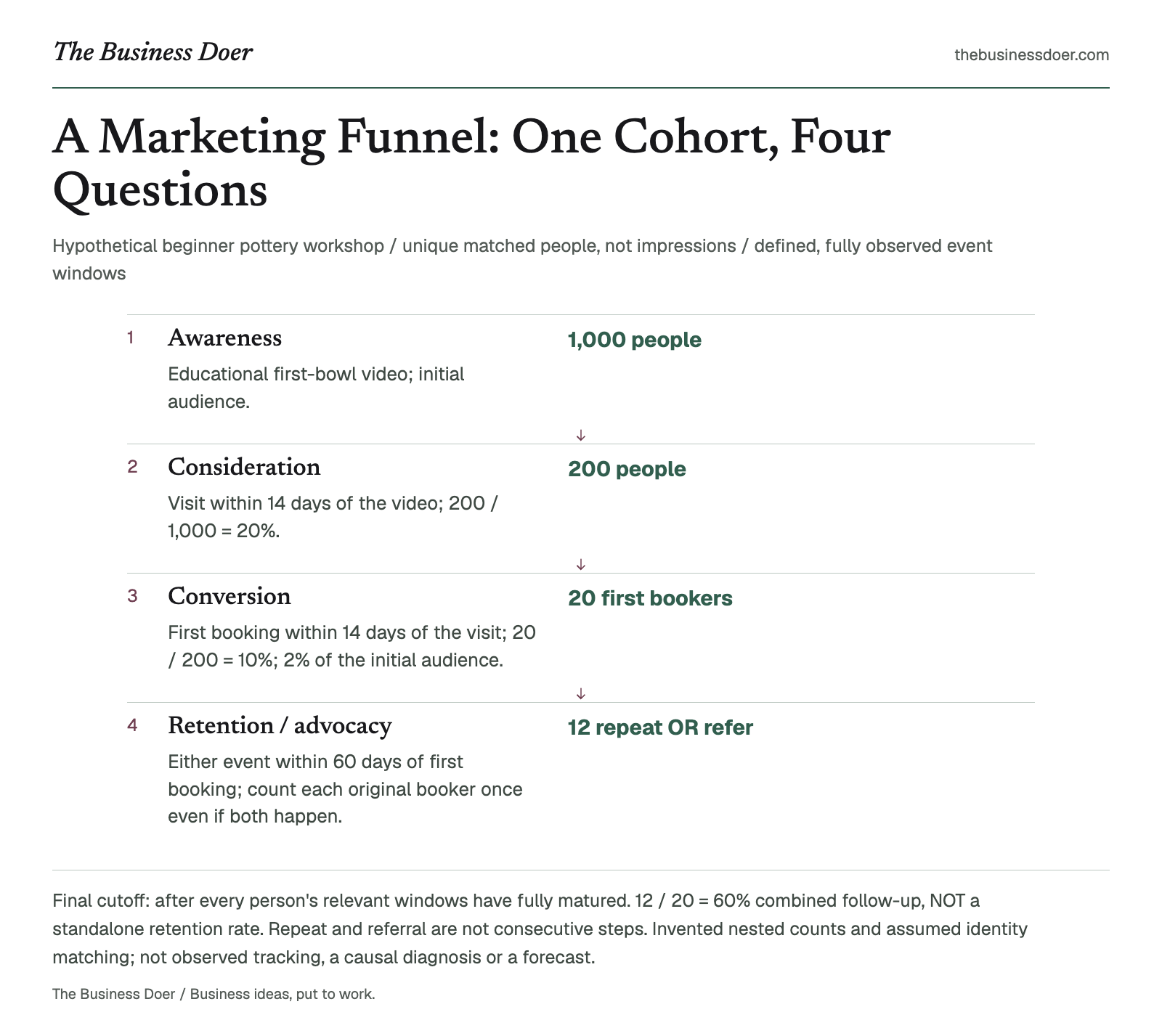
Visual reference. Final cutoff: after every person's relevant windows have fully matured. 12 / 20 = 60% combined follow-up, NOT a standalone retention rate. Repeat and referral are not consecutive steps. Invented nested counts and assumed identity matching; not observed tracking, a causal diagnosis or a forecast.
Text version
Hypothetical beginner pottery workshop / unique matched people, not impressions / defined, fully observed event windows
- Awareness
- 1,000 people. Educational first-bowl video; initial audience.
- Consideration
- 200 people. Visit within 14 days of the video; 200 / 1,000 = 20%.
- Conversion
- 20 first bookers. First booking within 14 days of the visit; 20 / 200 = 10%; 2% of the initial audience.
- Retention / advocacy
- 12 repeat OR refer. Either event within 60 days of first booking; count each original booker once even if both happen.
Why does it matter?
A marketing funnel helps a business:
- match information to what people need at each stage;
- see where potential customers lose interest or encounter friction;
- set a clear purpose for each campaign or piece of content;
- connect attracting new people with keeping existing customers.
The Bullseye Framework can help a business test channels that bring relevant people into the funnel. The funnel then shows what should happen after that first contact. An Ideal Customer Profile can help clarify who is a good fit before judging traffic volume alone.
How does it work?
1. Awareness
People recognize a need, problem, category or brand. Marketing should help the right audience discover and understand the problem rather than demand an immediate purchase.
Examples include educational articles, local events, search visibility, referrals and introductory advertising.
2. Consideration
People investigate possible solutions and decide which options deserve attention. They may compare benefits, read reviews, ask questions or examine prices.
Useful marketing can include clear service pages, demonstrations, FAQs, testimonials and helpful email follow-ups. A Value Proposition Canvas can help clarify which benefits and customer needs the message should emphasize.
3. Conversion
The person takes the desired action. A conversion may be a purchase, booking, registration, donation or another action that matters to the business.
At this stage, the offer and next step should be clear. Unnecessary forms, confusing prices or weak calls to action can create friction.
4. Retention and advocacy
Marketing continues after the first conversion. The business helps customers succeed, return and recommend the offer to others through useful follow-up, dependable service, loyalty activity or referral requests.
This supports the Customer Relationships part of the Business Model Canvas. For distinct lifecycle measures, the AARRR Funnel separates retention from referral. A returning customer and a customer who recommends the offer are not automatically the same person.
A simple example
Hypothetical example: A local studio markets a weekend pottery workshop for beginners. All counts below are invented teaching inputs, not observed campaign results.
| Stage | Defined customer behavior | Unique people |
|---|---|---|
| Awareness | View the educational first-bowl video. | 1,000 |
| Consideration | Visit the workshop page after the video. | 200 |
| Conversion | Complete a first class booking after that visit. | 20 |
| Retention / advocacy | Book again or refer a friend after the first booking. | 12 |
For this illustration, assume the later groups are nested subsets of the same 1,000 people, matched consistently. Visits occur within 14 days of the video, first bookings within 14 days of the page visit, and either follow-up event within 60 days of first booking. The final cutoff is after every eligible person has had the full relevant window. These windows are example definitions, not industry standards.
Count a person in the final group only once even if they both return and refer. The 12 are a combined follow-up group, not a separate count of repeat customers or referred new customers. The example does not supply those separate totals.

A fictional beginner workshop gives the campaign example a concrete setting. This generated scene is not a real class, testimonial or evidence of bookings, referrals or marketing performance.
How to calculate a stage rate
Stage conversion rate = people reaching the next stage / eligible people in the current group x 100
For the pottery example:
- Video audience to workshop-page visit: 200 / 1,000 x 100 = 20%.
- Page visit to first booking: 20 / 200 x 100 = 10%.
- First bookers with a repeat booking or referral: 12 / 20 x 100 = 60% combined follow-up.
- Initial video audience to first booking: 20 / 1,000 x 100 = 2%.
The last 60% is not a standalone retention rate, a referral conversion rate or 100% minus churn. Measure repeat booking and referrals separately when that is the question. The 1.2% who appear in the combined final group out of the initial audience must not be mislabeled as the first-booking conversion rate.
The 10% page-to-booking result does not explain why other visitors did not book. It identifies a transition worth investigating. Check whether the schedule, price, offer or booking process creates uncertainty, rather than inferring the cause from the percentage.
In real reporting, impressions, sessions, unique people and unrelated monthly totals are not interchangeable. If privacy-appropriate evidence cannot connect the groups, keep the separate stage measures but do not invent a transition rate. An unknown count stays unknown; a zero denominator makes the rate undefined, not 0%.
When should you use it?
Use a marketing funnel when:
- planning a campaign across several customer touchpoints;
- deciding what content or offer belongs at each stage;
- diagnosing why attention is not becoming action;
- coordinating marketing with sales or customer service;
- reviewing how acquisition connects to retention.
How to interpret the result
Do not assume the smallest number is automatically a failure. A funnel naturally narrows, and a relevant audience is more valuable than large but poorly matched traffic.
Compare stage results with the same business over time, using consistent definitions, comparable cohorts and mature observation windows. Recent customers may simply not have had enough time to return.
If awareness grows but consideration does not, the audience or message may be poorly matched. If consideration is strong but conversion is weak, inspect the offer and the action process. If purchases rise but repeat behavior remains low, examine the customer experience after conversion. These are hypotheses to investigate, not diagnoses from the counts.
Common confusion
A marketing funnel covers the broader journey from awareness through conversion and the continuing relationship. A Sales Funnel usually focuses more closely on progression toward a sale; a sales-managed version may track qualification, conversations, proposals and closing. Terminology overlaps, so define the scope rather than assuming a universal boundary.
The AIDA Model describes Attention, Interest, Desire and Action in persuasive communication. It can inform messages inside a funnel, but it is not the entire marketing system.
Common mistakes
- Treating stage names as universal. Choose definitions that fit the business and use them consistently.
- Using the same message everywhere. Someone learning about a problem needs different information from someone ready to book.
- Measuring traffic alone. Attention without meaningful progression can hide a weak funnel.
- Ignoring existing customers. Stopping at the first purchase leaves retention and referrals unplanned.
- Assuming a straight path. People may pause, skip stages, compare again or return through another channel.
- Mixing counting units or incomplete windows. Visits are not necessarily people; a recent booker has not yet completed a 60-day follow-up window.
Limitations
A funnel simplifies customer behavior. Real journeys are often nonlinear, different segments behave differently, and a stage metric rarely proves what caused a result. The model should guide questions and tests, not replace customer research or judgment.
Cross-channel identity matching may be incomplete or inappropriate. A coherent planning map is still useful when reliable transition counts are unavailable. Do not add tracking or infer identities merely to make the numbers fit the diagram.
Quick checklist
Put it to work: sketch a marketing funnel in 25 minutes
- Choose one audience and action: 4 minutes. Name the people you want to reach and the first conversion action.
- Draw four stages: 3 minutes. Write Awareness, Consideration, Conversion and Retention/Advocacy.
- Add one customer action per stage: 6 minutes. Examples include viewing educational content, checking the offer, booking and a defined post-booking behavior.
- Add one marketing response: 6 minutes. Decide which message, content or experience should support each action.
- Choose one measure per stage: 4 minutes. Define the counting unit and observation rule. Only calculate transitions when the groups can be matched consistently.
- Find one uncertainty: 2 minutes. Choose a transition to investigate, a conversation or small test, and a review point with sensible guardrails.
The goal is a usable first map, not a perfect forecast. Missing counts should become an evidence question, not a guessed figure.
Use one action and a clear measure per stage. Repeat booking and referral can overlap: count a person once in the combined last group, or measure the behaviors separately.
Awareness
- Customer action
- Not recorded.
- Marketing response
- Not recorded.
- Measure
- Not recorded.
Consideration
- Customer action
- Not recorded.
- Marketing response
- Not recorded.
- Measure
- Not recorded.
Conversion
- Customer action
- Not recorded.
- Marketing response
- Not recorded.
- Measure
- Not recorded.
Retention / advocacy
- Customer action
- Not recorded.
- Marketing response
- Not recorded.
- Measure
- Not recorded.
Before downloading (17 checks)
- Audience: add the missing context.
- Offer / conversion action: add the missing context.
- Investigation question: add the missing context.
- Next evidence test: add the missing context.
- Review point: add the missing context.
- Awareness: add a customer action.
- Awareness: add a marketing response.
- Awareness: add a measurement rule.
- Consideration: add a customer action.
- Consideration: add a marketing response.
- Consideration: add a measurement rule.
- Conversion: add a customer action.
- Conversion: add a marketing response.
- Conversion: add a measurement rule.
- Retention / advocacy: add a customer action.
- Retention / advocacy: add a marketing response.
- Retention / advocacy: add a measurement rule.
Key takeaways
- A marketing funnel maps awareness, action and an ongoing customer relationship.
- The four stages are a useful beginner model, not universal names or a compulsory straight path.
- Each stage needs its own customer action, marketing response and measure.
- Rates require comparable, matched groups and complete observation windows; they do not establish a cause.
- Combined repeat-or-referral behavior is not the same measure as retention alone.
Final takeaway
A marketing funnel turns a broad customer journey into manageable stages. It helps a business decide what people need next and where progress needs investigation.
Keep the first version simple: define the audience, map awareness through the post-conversion relationship, choose one meaningful action per stage, and improve the model with real customer evidence.