Operating Expenses: What They Are and How to Calculate Them
Classify the costs. Reconcile the total. Explain the change.
On this page
Operating expenses are the costs a business incurs to run its normal operations that are not included in cost of goods sold. They commonly include selling and administrative costs such as office salaries, rent, marketing, software, insurance and depreciation of office equipment.
They matter because a business can earn a healthy gross profit and still lose money if the wider costs of running the organization are too high.
What are operating expenses?
Operating expenses, often shortened to OPEX, are expenses from the day-to-day running of a business outside the cost assigned to the products or services sold.
In a simplified multi-step income statement:
Net sales - Cost of goods sold = Gross profit
Gross profit - Operating expenses = Operating profit
The exact labels and classifications can differ between companies and accounting frameworks. Use the company's accounting policy consistently and avoid double counting. This guide's simplified operating-profit calculation assumes there are no additional operating income or expense lines outside the totals shown.

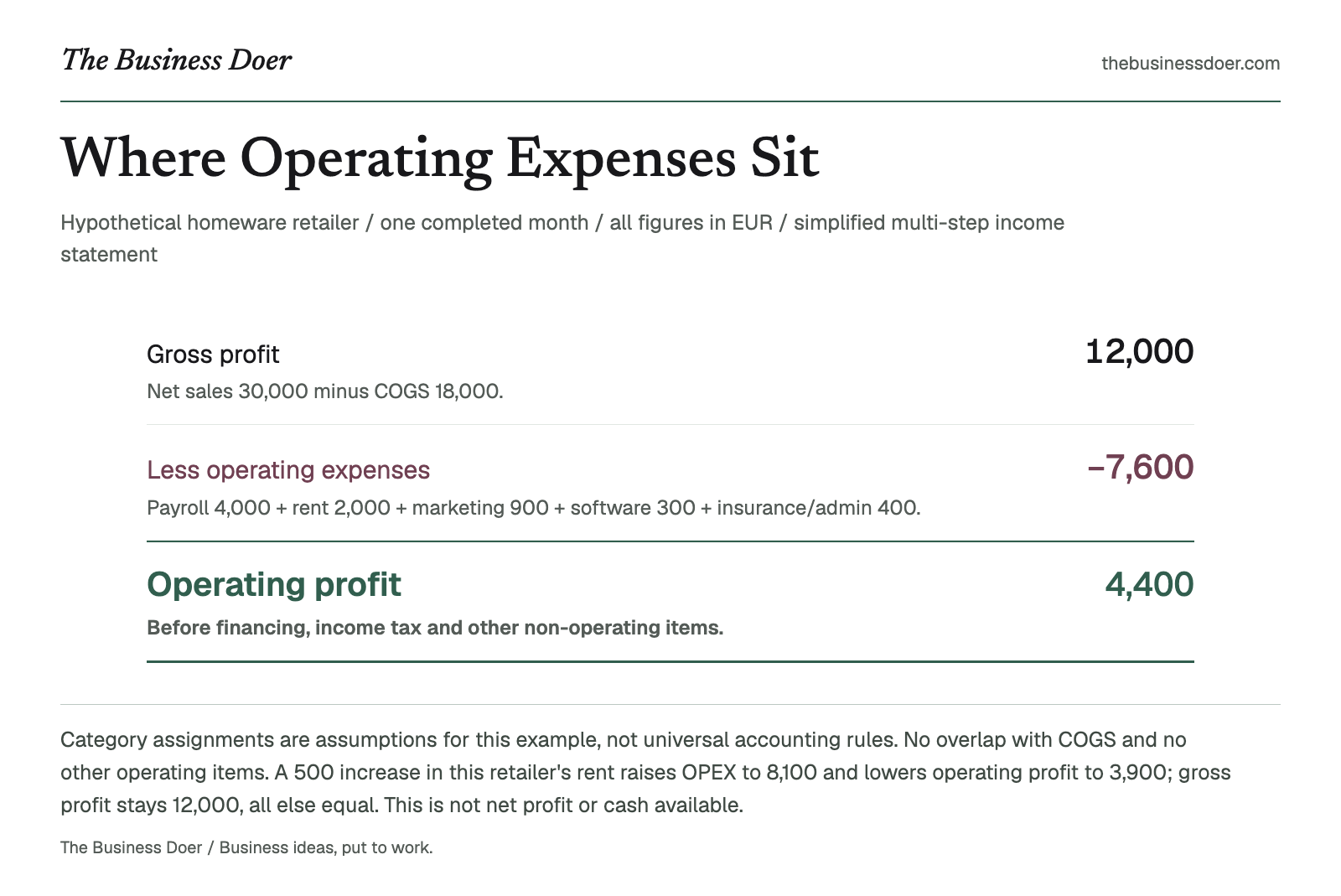
Visual reference. Category assignments are assumptions for this example, not universal accounting rules. No overlap with COGS and no other operating items. A 500 increase in this retailer's rent raises OPEX to 8,100 and lowers operating profit to 3,900; gross profit stays 12,000, all else equal. This is not net profit or cash available.
Text version
Hypothetical homeware retailer / one completed month / all figures in EUR / simplified multi-step income statement
- Gross profit
- 12,000. Net sales 30,000 minus COGS 18,000.
- Less operating expenses
- −7,600. Payroll 4,000 + rent 2,000 + marketing 900 + software 300 + insurance/admin 400.
- Operating profit
- 4,400. Before financing, income tax and other non-operating items.
Why do operating expenses matter?
Operating expenses explain what happens between gross profit and operating profit. They help a business see whether administrative and selling costs are growing faster than gross profit, understand the effect of new staff or recurring contracts, and judge whether its operating structure is sustainable.
A rising operating-expense total is not automatically bad. A company may spend more because it is expanding. The useful question is whether those expenses support enough revenue and gross profit to justify the additional cost.
What is included in operating expenses?
Common categories include:
- Selling expenses: advertising, sales-team salaries, certain commissions and promotional costs.
- General and administrative expenses: office rent, administrative salaries, accounting, insurance, subscriptions and office supplies.
- Other operating expenses: some businesses separately present functions such as research and development expense.
Classification depends on the cost's function and the applicable accounting policy. Production salaries, factory rent or production depreciation may belong in inventory cost and COGS rather than in the operating-expense total used here. A cost should not move between COGS and operating expenses merely to make one subtotal look better.
A simple example
Hypothetical example: A small homeware retailer reviews one completed month. The figures and category assignments are assumptions for this teaching retailer, not an observed business's results or general accounting instructions.

An illustrative homeware shop makes the monthly expense review tangible. This generated scene is not an actual retailer, accounting record or evidence of the example's costs or profit.
First, it establishes gross profit for the month:
| Income-statement item | Amount |
|---|---|
| Net sales | EUR 30,000 |
| Cost of goods sold | EUR 18,000 |
| Gross profit | EUR 12,000 |
It then groups the expenses that its accounting policy places outside COGS:
| Operating-expense category | Monthly expense |
|---|---|
| Selling and administrative payroll | EUR 4,000 |
| Shop and office rent | EUR 2,000 |
| Marketing | EUR 900 |
| Software | EUR 300 |
| Insurance and administration | EUR 400 |
| Total operating expenses | EUR 7,600 |
Operating expenses = 4,000 + 2,000 + 900 + 300 + 400 = EUR 7,600
Operating profit = EUR 12,000 - EUR 7,600 = EUR 4,400
The retailer retains EUR 12,000 after COGS, but EUR 7,600 is needed to run the wider operation before financing, tax and other non-operating items. The expense categories exclude costs already counted in COGS. Any depreciation assigned to either cost group is included once, not deducted again.
If rent rises by EUR 500 while sales, COGS and every other expense stay unchanged, operating expenses rise to EUR 8,100 and operating profit falls to EUR 3,900. Gross profit remains EUR 12,000 because this retailer's rent is outside COGS in the example.
When should you use them?
Review operating expenses when preparing a budget, checking an income statement, investigating a change in operating profit, adding staff or recurring software, or comparing the cost structure of two periods.
Compare like with like. If one period classifies a cost in COGS and another places the same type of cost in operating expenses, the comparison can be misleading even when total expenses are unchanged. Reconcile the classification change before interpreting the subtotals.
How should you interpret the result?
Start with the total, then identify which categories changed.
A EUR 10,000 increase caused by opening a new location means something different from the same increase caused by duplicate subscriptions or recurring rework. The total alone does not establish the cause or justify a cut.
Also compare the change with gross profit. If gross profit rises by EUR 50,000 while operating expenses rise by EUR 10,000, operating profit improves by EUR 40,000 in this simplified model. If gross profit is flat while operating expenses rise by EUR 10,000, operating profit falls by that amount, all else equal.
For a wider diagnosis of price, volume and cost drivers, use Profitability Analysis.
Common confusion
Operating expenses vs COGS
Cost of Goods Sold is the cost assigned to goods or services sold. Operating expenses are the costs of running the wider business that are not included in COGS.
The distinction affects gross profit, so classification must be consistent. A cost that is already in COGS must not be subtracted again as OPEX.
Operating expenses vs fixed costs
They are not the same. Operating expenses describe where a cost belongs in the business or income statement. Fixed and variable describe how a cost behaves as activity changes. Rent can be both an operating expense and a fixed cost. A sales commission can be an operating expense and vary with sales. Operating expenses can also be mixed, with fixed and variable elements.
Operating expenses vs capital expenditure
Buying a long-lived asset is not necessarily recorded as an operating expense immediately. Depending on the accounting rules, the asset may be capitalized and its cost recognized over time through depreciation or amortization.
Do not automatically put an equipment purchase into OPEX because cash was paid. Include any depreciation or amortization in the appropriate cost line once, without adding the asset purchase or a second depreciation charge on top.
Common mistakes
- Treating every cash payment as an operating expense.
- Mixing COGS and operating expenses between periods.
- Assuming every operating expense is fixed.
- Cutting the largest expense without checking what value it supports.
- Counting the same cost in both COGS and operating expenses.
- Treating a subtotal of confirmed items as the complete expense total while other items remain unresolved.
Limitations
Operating expenses do not show the full profitability or cash position of a business. They exclude costs classified elsewhere and do not explain whether a particular expense creates value. Accounting policies can also affect classification.
A simplified total cannot establish that the records are complete or that classifications are correct. Check the underlying statement and supporting records, and resolve uncertain items with the person responsible for the accounts before reporting a complete operating result.
Quick checklist
Put it to work: review one month in 25 minutes
Choose one completed month from real or practice records and use a single currency and business scope.
- Find gross profit for that month and record the statement or records it comes from.
- List expenses recorded below gross profit and before financing, tax and other non-operating items. Check that no cost is already included in COGS.
- Group the expenses into useful categories. The example uses five: selling and administrative payroll, premises, marketing, software, and insurance and administration. Use the groups that fit your records, and reconcile the grouped amounts to those records.
- Mark each category as confirmed OPEX, uncertain, or excluded from OPEX. Investigate uncertain or mixed categories rather than guessing. For excluded amounts, record where they belong and why.
- Add confirmed operating expenses. Calculate gross profit minus the complete OPEX total only after resolving every uncertain classification and confirming that all operating expenses for the chosen scope and month are included without duplication.
- Compare the two largest confirmed categories with the previous month when matching figures are available. Check the same category definitions and business scope; these two comparisons do not establish a complete previous-month OPEX total or operating-profit change.
- Write two evidence-based follow-up questions, with one for each meaningful change you want to investigate and the record or explanation needed to check it. If previous figures are unavailable, frame them as questions to research rather than observed changes. Identify one-off or unusual items separately.
The output is a reconciled operating-expense total, the resulting simplified operating profit and two specific follow-up questions supported by evidence. Until classification and completeness checks are finished, treat the confirmed sum as a partial subtotal and leave the full operating result unresolved.
Net sales minus COGS for the same month; a gross loss may be entered with a minus sign.
Classify costs using your records, not their name alone. Exclude anything already in COGS, financing, income tax or capitalized purchases. Category amounts must be nonnegative; resolve credits or recoveries outside this simplified review.
- Provisional confirmed-row subtotalValid confirmed amounts only; not a complete OPEX figure
- EUR 0.00
No complete operating result yet. Resolve classifications, record the basis and two evidence questions, then confirm completeness.
Review incomplete entries (27)
- Gross profit: Enter an amount; blank is not zero.
- Category 1: record the category name.
- Category 1: Enter an amount; blank is not zero.
- Category 1: record evidence or the classification question.
- Category 1: resolve its classification before a complete result.
- Category 2: record the category name.
- Category 2: Enter an amount; blank is not zero.
- Category 2: record evidence or the classification question.
- Category 2: resolve its classification before a complete result.
- Category 3: record the category name.
- Category 3: Enter an amount; blank is not zero.
- Category 3: record evidence or the classification question.
- Category 3: resolve its classification before a complete result.
- Category 4: record the category name.
- Category 4: Enter an amount; blank is not zero.
- Category 4: record evidence or the classification question.
- Category 4: resolve its classification before a complete result.
- Category 5: record the category name.
- Category 5: Enter an amount; blank is not zero.
- Category 5: record evidence or the classification question.
- Category 5: resolve its classification before a complete result.
- Confirm the cost boundary and completeness after reviewing your entries.
- Record the business scope.
- Record the completed month.
- Record the gross-profit basis and classification policy.
- Record the first evidence question.
- Record the second evidence question.
Key takeaways
- Operating expenses are normal business-running costs not included in COGS.
- In a simplified multi-step income statement, gross profit minus operating expenses gives operating profit.
- Operating expenses can be fixed, variable or mixed.
- Higher operating expenses are not automatically negative if they support stronger business performance.
- Consistent classification, complete records and no double counting are essential for useful comparisons.
Final takeaway
Operating expenses show what it costs to run the wider business after the cost of sales has been recognized. They connect gross profit with operating profit.
Classify them consistently, examine the categories behind the total and interpret changes alongside gross profit. The goal is to understand what the business is spending and how that spending affects the operating result.