Operating Profit: What It Is and How to Calculate It
After operating costs. Before interest and income tax.
On this page
Operating profit is the profit a business earns from its operations before interest and income tax. It is commonly calculated by subtracting operating expenses from gross profit. The figure helps show whether the core business is profitable before financing and tax effects are considered.
You may also see operating profit called operating income or income from operations.
What is operating profit?
Operating profit is a subtotal on the income statement. In a simple multi-step statement, it sits below gross profit and operating expenses, but above items such as interest and income tax.
Operating profit = Gross profit - Operating expenses
Because gross profit is net sales minus cost of goods sold, the same idea can also be written as:
Operating profit = Net sales - Cost of goods sold - Operating expenses
The exact presentation can vary by company and accounting rules, so check which revenues and costs are included. This guide's simplified calculation assumes there are no additional operating income or expense lines outside the totals shown; it is not a universal reconstruction of every company's statement.

Visual reference. Invented teaching figures. No additional operating items outside these totals. Operating profit is not net profit, EBITDA or cash available; do not add back depreciation.
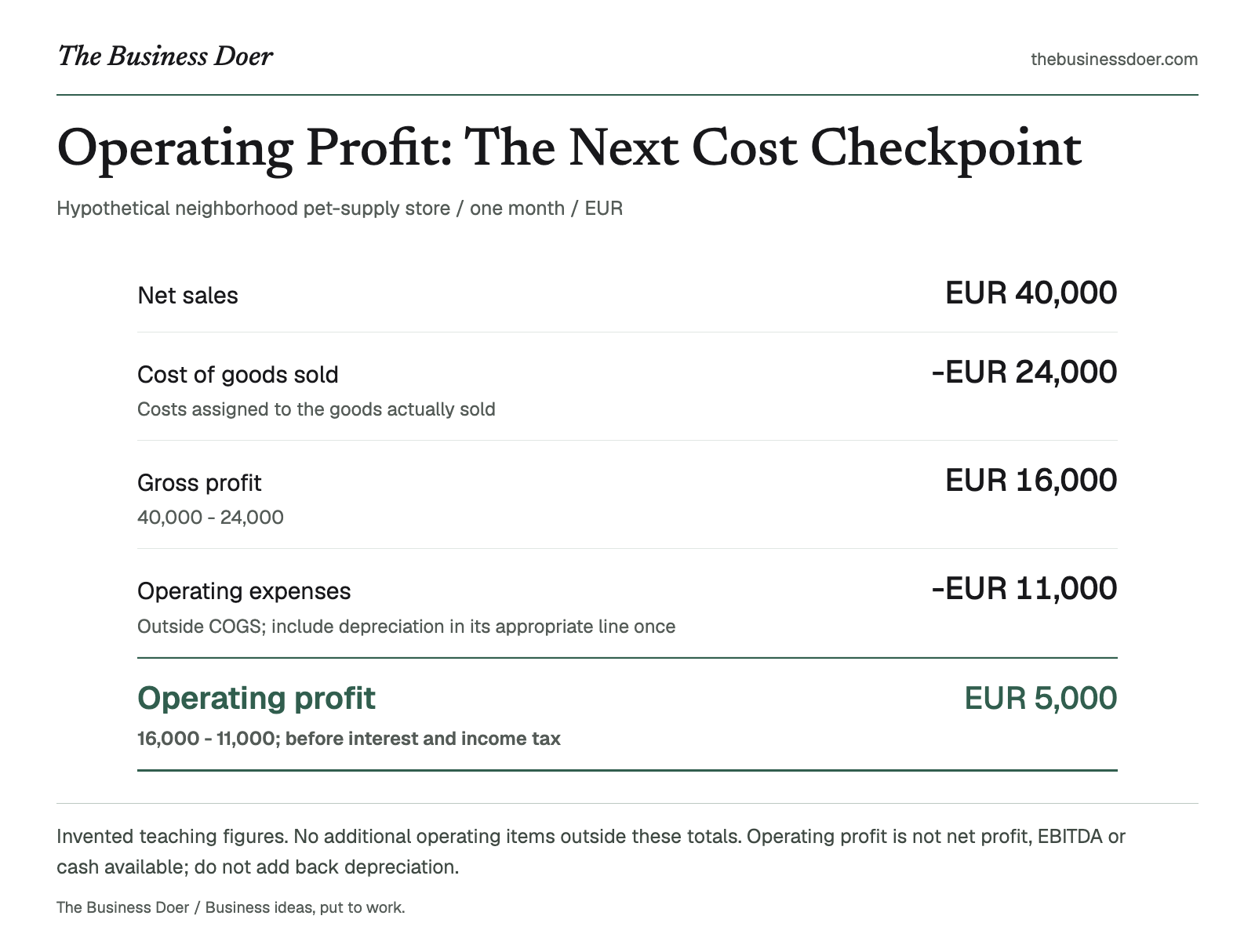
Text version
Hypothetical neighborhood pet-supply store / one month / EUR
- Net sales
- EUR 40,000
- Cost of goods sold
- -EUR 24,000. Costs assigned to the goods actually sold
- Gross profit
- EUR 16,000. 40,000 - 24,000
- Operating expenses
- -EUR 11,000. Outside COGS; include depreciation in its appropriate line once
- Operating profit
- EUR 5,000. 16,000 - 11,000; before interest and income tax
Why does it matter?
Operating profit focuses on the economics of running the business. It helps answer:
- Are operations producing a profit?
- Are operating expenses growing faster than gross profit?
- Is higher sales volume actually improving operating performance?
- Is there enough operating profit to absorb interest and taxes later in the income statement?
A company can have strong sales and gross profit but weak operating profit if operating expenses are too high.
The formula and how it works
Gross profit
Gross Profit is net sales minus cost of goods sold. It measures what remains after the costs assigned to the products or services sold. The Cost of Goods Sold guide explains that cost layer in more detail.
Operating expenses
Operating expenses are the costs of running the business that are not included in cost of goods sold. They may include administrative salaries, rent, marketing, office costs and depreciation, depending on classification.
Subtract operating expenses from gross profit to reach operating profit. A positive result means gross profit exceeded the operating expenses included in the calculation. A negative result is an operating loss.
Include depreciation and amortization in the appropriate operating cost lines once. If an amount is already included in COGS, do not subtract it again as an operating expense.
A simple example
Hypothetical example: A neighborhood pet-supply store reviews one month. The figures are illustrative, not an observed store's results.
| Income-statement item | Amount |
|---|---|
| Net sales | EUR 40,000 |
| Cost of goods sold | -EUR 24,000 |
| Gross profit | EUR 16,000 |
| Operating expenses | -EUR 11,000 |
| Operating profit | EUR 5,000 |
First, the store calculates gross profit: EUR 40,000 - EUR 24,000 = EUR 16,000.
Then it subtracts operating expenses: EUR 16,000 - EUR 11,000 = EUR 5,000.
The store earned EUR 5,000 from the operating revenues and costs included for the month, before interest and income tax. It is not necessarily final profit because other items may still appear later. The EUR 11,000 excludes costs already counted in COGS; depreciation assigned to either cost group is not added back.

A neighborhood retailer gives the operating-profit example a concrete setting. This generated scene is illustrative, not an observed store or evidence of sales, goods sold, expenses, cash receipts or profit.
When should you use it?
Operating profit is useful when reviewing an income statement, comparing periods, preparing a budget or investigating why profit changed.
It is especially useful when you want to separate operations from financing choices. Two businesses may have similar operations but different interest costs because they use different amounts of debt. This operating-profit calculation stops before that interest expense.
Use the same definitions from period to period. If a cost moves between COGS, operating expenses and another category, the comparison can become misleading even if the underlying business has not changed. Reconcile material classification changes before comparing results.
How to interpret the result
A positive operating profit means the included operating revenues exceeded the included operating costs. A negative figure means those operations produced an operating loss.
If operating profit rises from EUR 5,000 to EUR 8,000, investigate whether the change came from higher sales, stronger gross profit, lower operating expenses or a combination. The arithmetic alone does not explain price, volume, product mix or other underlying causes.
There is no universal operating profit amount that is "good." Larger businesses often report larger absolute figures. For comparisons across businesses or periods of different size, operating margin adds context:
Operating margin = Operating profit / Net sales x 100
For the store, EUR 5,000 / EUR 40,000 x 100 = 12.5%. This is not its gross margin or net profit margin. With zero net sales, this percentage is undefined, even though an operating loss can still be calculated.
The Gross Margin guide explains the same amount-versus-percentage distinction at the gross-profit level.
Common confusion
Operating profit vs gross profit
Gross profit subtracts COGS from net sales. Operating profit goes one step further and also subtracts operating expenses.
Operating profit vs net profit
Net Profit is calculated after later items such as interest and income tax are included. Operating profit stops earlier. Positive operating profit does not guarantee positive net profit.
Operating profit vs EBITDA
They are not automatically the same. Operating profit includes depreciation and amortization assigned to the operating cost lines, whether in COGS or operating expenses; EBITDA is designed to exclude those charges. Do not add them back when calculating operating profit.
Common mistakes
- Subtracting operating expenses twice. If a cost is already included in COGS, do not subtract it again as an operating expense.
- Treating operating profit as cash flow. Profit is an accounting result; cash receipts and payments can occur at different times.
- Mixing periods. Sales, COGS and operating expenses must cover the same period.
- Assuming positive operating profit means positive net profit. Interest, taxes and other items may still reduce the final result.
- Comparing companies without checking classifications. Businesses can classify some costs differently.
Limitations
Operating profit does not show the complete financial picture. It does not by itself explain cash flow, debt levels, taxes, capital spending or the quality of accounting estimates. Cost classifications and other operating items can also affect it. Inspect the actual statement and its accounting policies rather than treating this simplified formula as an adjusted or recurring-profit measure.
Use operating profit as one income-statement checkpoint, not a complete measure of business health.
Quick checklist
Put it to work: a 20-minute operating-profit check
Choose one completed month from a real or practice income statement.
- Write down net sales for the month.
- Record COGS and calculate gross profit.
- List operating expenses for the same month, excluding items already counted in COGS.
- Calculate: gross profit - operating expenses = operating profit.
- Compare with the previous month only after confirming the same scope and consistent cost classifications.
- Write one hypothesis about the largest change, together with the evidence needed to test it.
Finish with: "Operating profit tells us ___, but it does not tell us ___."
If any cost classification changed between the months, stop the comparison until the figures are made consistent. The worksheet is a simplified check using nonnegative sales and cost totals, not a full accounting statement or a model for additional operating items.
Enter nonnegative totals for the same period. Opex excludes costs already in COGS. Depreciation and amortization belong in their appropriate cost lines once; do not add them back.
No result yet. Record valid current totals and, when comparing, valid prior totals plus confirmed consistent classifications.
- Current net sales: Enter an amount; blank is not zero.
- Current COGS: Enter an amount; blank is not zero.
- Current operating expenses: Enter an amount; blank is not zero.
- Record the business scope.
- Record the cost classification and included operating items.
- Record the current period.
- Record the interpretation or next evidence check.
- Record the what operating profit does not tell you.
Key takeaways
- Operating profit is commonly gross profit minus operating expenses.
- It measures an operating subtotal before interest and income tax, under the stated accounting basis.
- Positive operating profit does not guarantee positive net profit or cash flow.
- Keep periods and cost classifications consistent, without counting a cost twice.
- Operating margin puts the amount in context relative to net sales; it is undefined at zero sales.
Final takeaway
Operating profit shows what remains after a business deducts the cost of what it sold and the operating expenses included in its calculation. In its simplest form, it is gross profit minus operating expenses.
Use it to understand operating performance before interest and income tax. If the result changes materially, a broader Profitability Analysis can help investigate whether sales, costs or another operating driver changed, without assuming the cause from one number.