Theory of Constraints: How to Find and Improve the Limiting Factor
One limiting factor. A whole-system improvement.
On this page
The Theory of Constraints (TOC) is a management framework for improving a system by focusing on the factor that most limits its overall performance. Instead of trying to improve every activity at once, TOC asks: what is currently preventing the whole system from achieving more of its goal?
The framework is associated with Eliyahu M. Goldratt and uses a repeating improvement process known as the Five Focusing Steps.
What is the Theory of Constraints?
A constraint is the part of a system that limits how much the system can achieve. It might be a machine, a team, an approval step, a policy, available demand or another limiting condition.
Improving a non-constraint may make one activity look more efficient without improving the system as a whole. In a simple serial process with comparable units, if one step can process 20 orders per hour while every other step can process 40, increasing another step from 40 to 50 does not raise the system's capacity above 20. The 20-order step still sets the capacity limit, assuming sufficient demand.
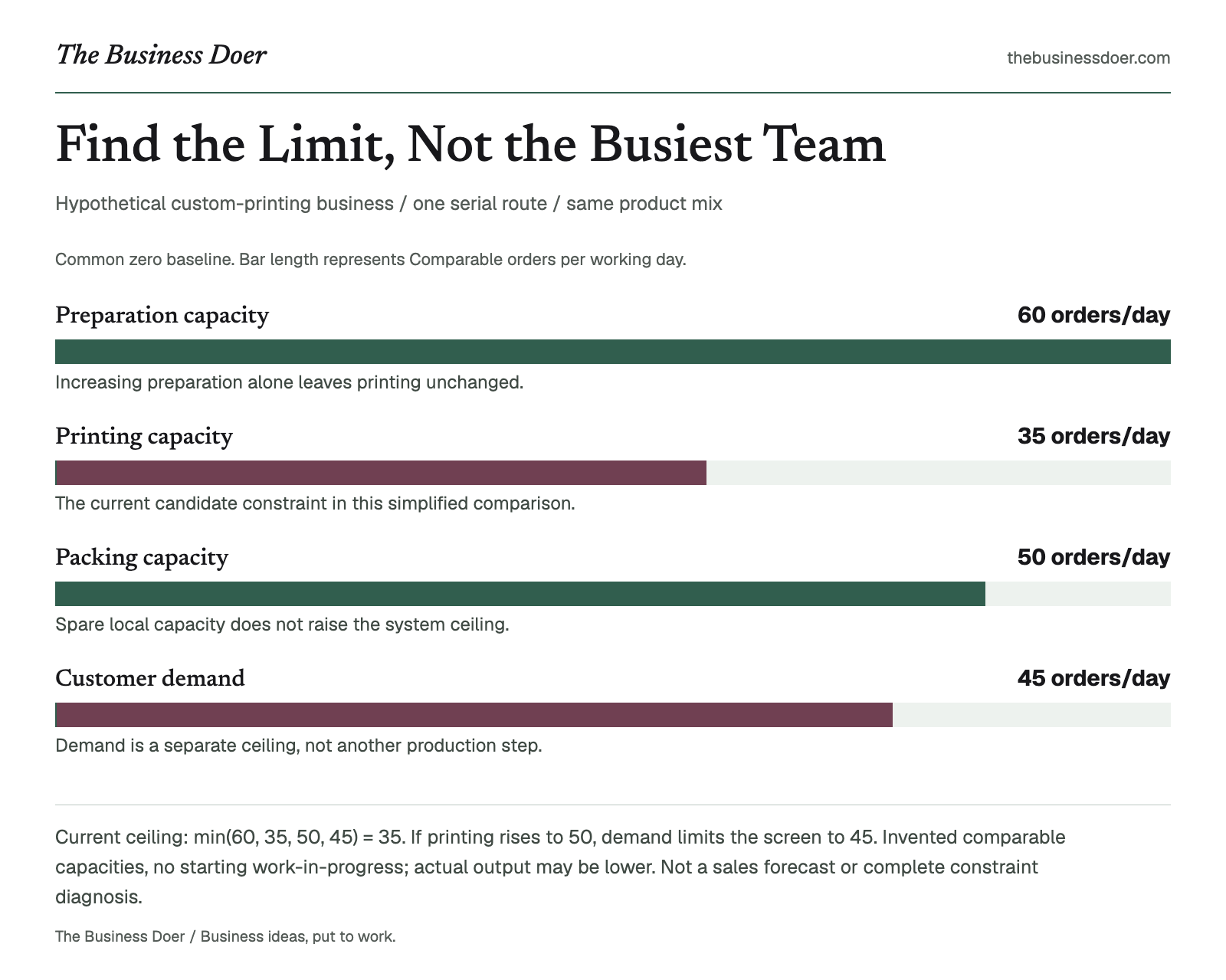
TOC therefore concentrates improvement effort on the current constraint. The following capacity comparison illustrates the idea; it is not a complete diagnosis of a real operation.

Visual reference. Current ceiling: min(60, 35, 50, 45) = 35. If printing rises to 50, demand limits the screen to 45. Invented comparable capacities, no starting work-in-progress; actual output may be lower. Not a sales forecast or complete constraint diagnosis.
Text version
Hypothetical custom-printing business / one serial route / same product mix
- Preparation capacity
- 60 orders/day. Increasing preparation alone leaves printing unchanged.
- Printing capacity
- 35 orders/day. The current candidate constraint in this simplified comparison.
- Packing capacity
- 50 orders/day. Spare local capacity does not raise the system ceiling.
- Customer demand
- 45 orders/day. Demand is a separate ceiling, not another production step.
Why does it matter?
Businesses often spread improvement work across many departments. That can consume money and attention without changing the result customers experience.
TOC helps distinguish between a local improvement and a system improvement. A local improvement makes one activity faster or busier. A system improvement raises the performance of the overall process.
This is useful when queues, delays, missed deadlines or capacity limits suggest that one part of a process is restricting the rest.
How it works: the Five Focusing Steps
1. Identify the constraint
Find the factor that currently limits the system's performance. Look for persistent queues, long waits, capacity shortages or a step that other work repeatedly depends on. A queue is a clue, not proof: check comparable capacity, actual output, downtime and customer demand.
2. Exploit the constraint
Get the best possible performance from the constraint using existing resources. Reduce avoidable downtime, interruptions, rework or low-priority work that consumes its limited capacity.
Here, "exploit" means use the constraint effectively, not exploit people. Preserve safe working conditions, required maintenance and quality standards.
3. Subordinate everything else
Align the rest of the system around the constraint. Non-constraints should support its flow rather than maximize their own activity.
Producing work faster upstream is not helpful if it only creates a larger queue before the constraint. Coordinate releases and handoffs so the limiting step has the right inputs without unnecessary work-in-progress.
4. Elevate the constraint
If the constraint still limits performance after those checks, increase its capability. This may require investment, additional staff, equipment, outsourcing, redesign or a policy change. Check that the change can improve the system's goal, not merely one department's utilization.
5. Repeat
Once one constraint is relieved, another part of the system may become the new limiting factor. Return to step one. Do not let an old rule or habit become the next constraint.
A simple example
Hypothetical example: A small custom-printing business can prepare 60 orders per day, print 35 and pack 50. Customer demand is 45 orders per day. All numbers are invented teaching inputs, not measured business results.
| Factor | Comparable orders per day |
|---|---|
| Preparation capacity | 60 |
| Printing capacity | 35 |
| Packing capacity | 50 |
| Customer demand | 45 |
Assume every comparable order passes through all three steps, capacities refer to the same working day and product mix, and there is no starting inventory of partly finished orders. Interruptions, defects, rework, shared resources and variability are not separately modeled. Under these simplifying assumptions, printing sets a capacity ceiling of 35 completed orders per day; actual output may be lower.
The business applies the Five Focusing Steps:
- Identify: printing limits the simple process to at most 35 orders per day.
- Exploit: schedule required maintenance without compromising safety, and have the right materials ready before printing starts. Measure whether avoidable lost time falls.
- Subordinate: pace preparation and coordinate packing so they support printing without unnecessary work-in-progress.
- Elevate: if printing still limits the result and demand supports it, investigate extra printing capability or outsourcing.
- Repeat: measure the whole process after the change instead of assuming printing is still the constraint.
If printing could handle 50 orders per day, the simple screen would become min(60, 50, 50, 45) = 45 orders per day. Demand, not packing, would then set the ceiling. Packing becomes limiting only under different demand and capacity conditions. The extra ten orders are a conditional capacity opportunity, not promised sales or profit.

Illustrative custom-printing workshop. The scene does not document the example's capacities or the results of a real business.
The goal is not to make every department equally busy. It is to improve the factor that limits the whole system.
When should you use it?
TOC is useful when a process has a clear goal and performance appears limited by capacity, flow, a recurring queue or a restrictive rule. It can apply to operations, service delivery, projects, sales processes and other systems with dependent steps.
Before looking for a constraint, make sure the process boundaries are clear. A SIPOC Diagram can help create a high-level process view.
How to interpret the result
TOC does not produce a score. Its main result is a decision about where improvement attention should go next.
A useful constraint should explain why increasing activity elsewhere does not meaningfully improve the system's goal. After a change, measure the process again. If the previous constraint no longer limits performance, identify the new one.
A PDCA Cycle can help test a proposed improvement and check the result. If the verified constraint itself is underperforming and needs cause investigation, a Fishbone Diagram can organize possible explanations; those explanations still require evidence.
Common confusion
The Theory of Constraints is broader than bottleneck identification. Finding the bottleneck is only the first step. TOC also asks the organization to use that constraint well, align other activities around it, increase its capability when necessary and repeat the process.
It is also different from maximizing utilization everywhere. Keeping every resource constantly busy can create excess work-in-progress and longer queues without increasing system output.
Common mistakes
- Improving everything at once. TOC is about focus.
- Choosing the constraint by intuition alone. Use process data and observable evidence.
- Jumping directly to investment. First check whether existing capability is being wasted.
- Optimizing non-constraints for their own metrics. More local output can simply create more waiting.
- Assuming the constraint never moves. Measure the system again after improvement, including demand.
Limitations
TOC deliberately focuses attention on a small number of constraints. Real organizations can have changing demand, interacting restrictions, quality problems, uncertainty and external limits. Identifying the true constraint can therefore require more analysis than a simple capacity comparison.
The framework works best when the system goal, boundaries and performance measures are clear. The worksheet below is only an initial screen for a simple serial process, not a queueing simulation, a financial throughput-accounting calculation or proof of a policy constraint.
Quick checklist
Put it to work: a 20-minute constraint scan
Choose one real process with a clear output, such as fulfilling an order, approving a proposal or preparing a weekly report.
- Write the process goal and boundaries in one sentence.
- List four to seven main steps, or three for a deliberately simplified example.
- For each step, note comparable capacity and evidence about where work waits. Use the same output unit, period and mix, and include demand for that output.
- Mark the step, rule or resource that appears to limit total output. Treat a capacity minimum as a candidate, not a verified diagnosis.
- Write one exploit action that could help without new investment, and how other steps should support it.
- Write one measure and review date to check after the change.
- If the constraint improves, repeat the scan rather than assuming it still applies.
Keep the exercise factual. Missing evidence is a research task, not permission to invent a number. For complex routing, shared resources or policy constraints, use the notes to plan further investigation instead of forcing the process into this numerical model.
Use comparable output across a single serial route. All steps must handle the same unit, period and product mix. Decimal values are capacity rates, not partial completed orders.
- Name step 1.
- Step 1: Enter a capacity or demand amount.
- Name step 2.
- Step 2: Enter a capacity or demand amount.
- Name step 3.
- Step 3: Enter a capacity or demand amount.
- Demand: Enter a capacity or demand amount.
- Record the common output unit and period.
- Confirm comparable serial capacities and the model assumptions before calculating.
- Process goal and boundaries
- Demand evidence
- Step 1 evidence / observation
- Step 2 evidence / observation
- Step 3 evidence / observation
- Exploit action
- Supporting changes
- Outcome measure and guardrails
- Review point
Key takeaways
- TOC focuses improvement on the factor that currently limits the system as a whole.
- The Five Focusing Steps are identify, exploit, subordinate, elevate and repeat.
- Improving a non-constraint can make one activity look better without increasing overall performance.
- Constraints can move, including from internal capacity to demand; repeat the analysis after a change.
- A simple capacity screen helps frame a test. It does not replace observation or establish causation.
Final takeaway
The Theory of Constraints concentrates improvement where it can affect the whole system. Identify the limiting factor, use it effectively, align the rest of the process around it, increase its capability if necessary and then look for the next constraint.
Its practical lesson is simple: not every improvement has equal value. Improve the factor that currently limits the result.