Core Competencies: What They Are and How to Identify Them
Look beneath the products. Test the capability.
On this page
Core competencies are deeply learned organizational capabilities that create meaningful customer value, can support different products or markets, and are difficult for competitors to reproduce. They are not simply the products a company sells, the equipment it owns or a list of things employees do well.
C.K. Prahalad and Gary Hamel developed the concept in their 1990 Harvard Business Review article, The Core Competence of the Corporation.
What are core competencies?
A core competency combines skills, knowledge, processes, technologies and coordination that the organization has learned to use especially well.
The important word is combination. A machine, patent, brand or talented employee may be valuable. A competency is the repeatable ability to make resources work together, rather than merely possessing them.
Core competencies sit underneath products and services. An individual offer can disappear while the underlying capability remains useful elsewhere. The question is not just “What do we sell?” but “What have we learned to do that makes those offers possible?”

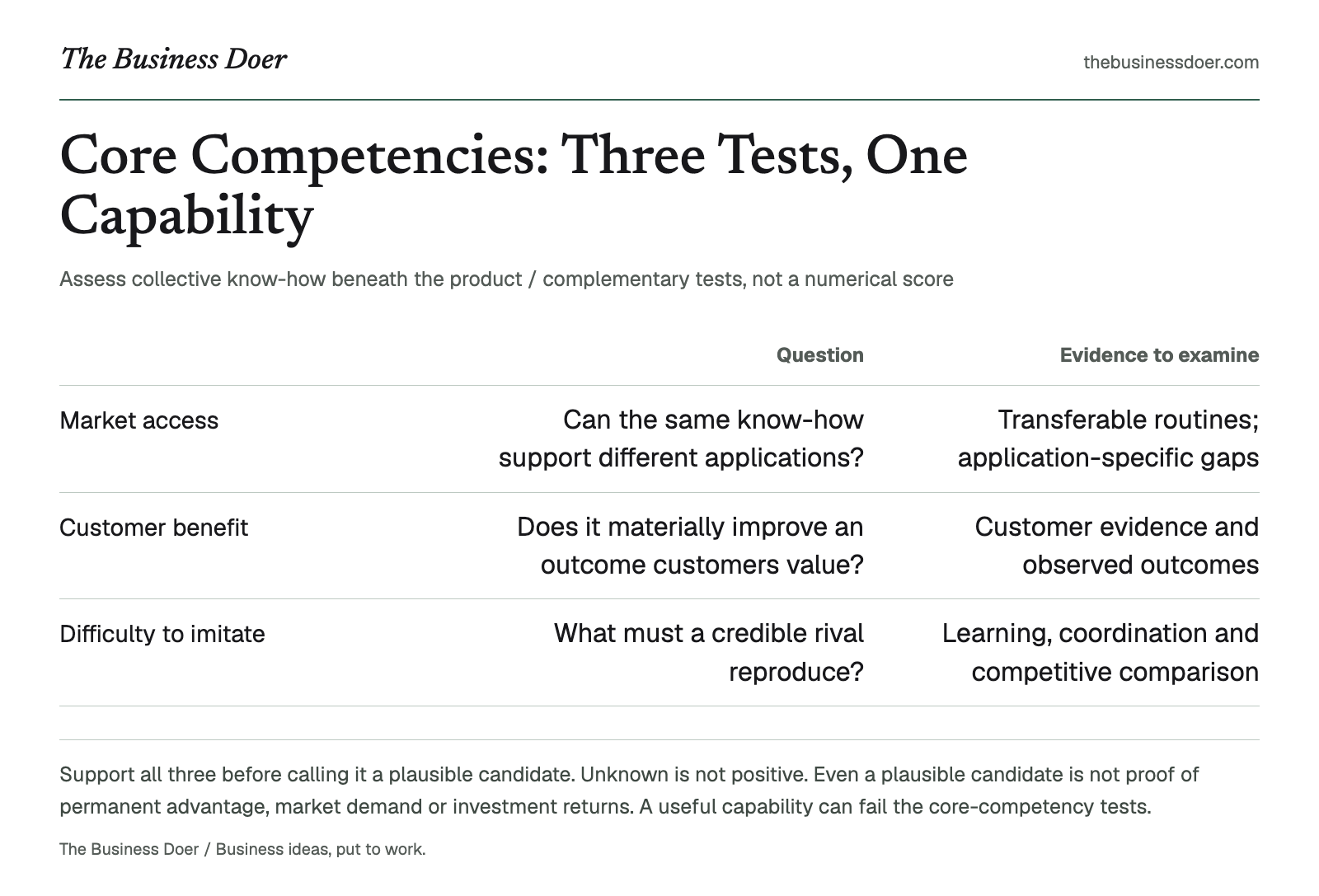
Visual reference. Support all three before calling it a plausible candidate. Unknown is not positive. Even a plausible candidate is not proof of permanent advantage, market demand or investment returns. A useful capability can fail the core-competency tests.
Text version
Assess collective know-how beneath the product / complementary tests, not a numerical score
- Market access
- Question: Can the same know-how support different applications?; Evidence to examine: Transferable routines; application-specific gaps
- Customer benefit
- Question: Does it materially improve an outcome customers value?; Evidence to examine: Customer evidence and observed outcomes
- Difficulty to imitate
- Question: What must a credible rival reproduce?; Evidence to examine: Learning, coordination and competitive comparison
Why do core competencies matter?
Identifying them can help managers decide which capabilities deserve investment, where existing know-how might support an adjacent offer, and what could be lost if an activity is outsourced without understanding its contribution.
The concept also challenges a comfortable assumption: being good at something does not necessarily make it strategically distinctive. A capability matters because of the decisions it can support, not because it sounds impressive on a strengths list. A competitive advantage still needs comparative customer and financial evidence; an internal capability claim is not that evidence.
The three tests
The classic tests ask whether the capability can open up different markets, contributes substantially to customer benefits and is hard to imitate. Use all three; one attractive characteristic is not enough.
Can it support different products or markets?
Look beyond the current offer. Name another application that would use substantially the same know-how, not a completely new capability hidden behind an optimistic label.
For the hypothetical packaging company below, rapid setup and coordination could serve short-run retail cartons and event materials. That is a transfer hypothesis, not proof that either market is commercially attractive. Each application still needs customers, economics and delivery evidence.
Does it create a meaningful customer benefit?
Describe what changes for the customer: a shorter wait, fewer errors, a better fit, reliable availability or another specific outcome.
“Excellent quality” is too vague to test. A more useful question for the packaging company is whether customers receive usable customized packs by the agreed date, with fewer approval revisions. Order records, complaints, repeat purchases and customer interviews could help test that claim. None alone proves why customers choose the business.
Is the whole capability difficult to imitate?
Separate a visible asset from the learning and coordination around it. If a rival can buy the same equipment and reproduce the result easily, the asset does not by itself establish a core competency.
For the example, investigate how artwork preparation, job sequencing, finishing knowledge and supplier coordination fit together. Ask what would have to be learned or rebuilt, and whether comparable rivals already do it. Complexity and company pride are not evidence of an imitation barrier.
Passing these tests provisionally identifies a candidate for deeper analysis. It does not prove permanent advantage.
A worked example: the print-and-packaging company
Hypothetical example. A small company reviews four claimed strengths. The judgments below are teaching assumptions, not observations about an actual company or its competitors.

Illustrative coordination of artwork preparation and packaging production for the hypothetical example; not an actual company or evidence of a competitive advantage.
| Candidate | What the company is really describing | Initial interpretation |
|---|---|---|
| A fast digital printer | A purchasable asset. | Useful equipment; ownership alone does not establish a collective capability or difficulty to copy. |
| An experienced designer | An individual’s skill. | A strength, but the company must show how knowledge is shared and repeatably coordinated beyond one person. |
| Friendly account handling | A broad service claim. | Too vague until the customer outcome and competitive comparison are specified. |
| Rapid, reliable short-run customization | Coordinated artwork preparation, scheduling, production knowledge and suppliers. | A more precise capability candidate; still needs evidence against all three tests. |
The last candidate is not simply “we print quickly.” It describes how the organization repeatedly prepares, produces and delivers varied small jobs without losing control of the specification.
For a first assessment, the team could record:
| Test | What would support the candidate? | What remains uncertain? |
|---|---|---|
| Market access | The same preparation and coordination routines work for short-run cartons, labels or event materials. | Which applications actually transfer without major new equipment, training or compliance work? |
| Customer benefit | Records and customer feedback connect the capability to reliable, timely customized work. | Is speed valuable enough to affect choice, or is price the main reason customers buy? |
| Imitation difficulty | Reliable results depend on accumulated cross-functional learning and relationships that rivals cannot readily reproduce. | Do comparable competitors already match the result with a standard process? |
This is a stronger candidate, not a confirmed finding. If the imitation comparison is missing, write “insufficient evidence” rather than promoting a plausible story into a strategic fact.
Strengths, resources and capabilities are not interchangeable
| Term | What it describes | Packaging example |
|---|---|---|
| Resource | Something the business controls or can access. | A printer, design files or a supplier relationship. |
| Strength | An advantageous attribute or something done well. | Experienced staff or a reputation for responsive service. |
| Capability | Something the organization can reliably do by combining resources. | Coordinate varied custom jobs from approved artwork to delivery. |
| Core competency | A capability with broader market usefulness, meaningful customer benefit and difficulty of imitation. | The coordinated customization capability, if the evidence supports all three tests. |
A valuable strength need not be core. Nor does failing the broader-market test mean an activity should be abandoned: a narrow capability may still be essential to the current business.
When should you use this concept?
Use it during strategy reviews, investment decisions, consideration of adjacent markets or outsourcing discussions. It is especially useful when several products seem unrelated but may draw on the same underlying know-how.
Value Chain Analysis helps locate the activities and connections involved. The VRIO Framework offers a complementary competitive test, including rarity and organizational support. They are not substitutes for one another: the three core-competency tests emphasize broader applications and customer benefits, while VRIO assesses the competitive potential of a resource or capability in context.
Before outsourcing part of the example’s process, map which knowledge and coordination it supports. Consider cost, quality, resilience and access to learning as well as the competency label. The label alone is neither an instruction to keep everything in-house nor permission to enter a new market.
Common mistakes
- Naming products instead of capabilities. “Custom labels” is an output; describe the know-how underneath it.
- Calling every strength core. Necessary equipment and competent staff can be valuable without being distinctive.
- Using broad slogans. Replace “innovation” or “great service” with a repeatable ability and a customer outcome.
- Assuming coordination is automatically rare. Compare the full capability with credible competitors, not a weak imaginary rival.
- Confusing possible reuse with proven demand. Transfer potential is not a market-entry business case.
- Treating unsupported answers as positive. Missing evidence needs investigation, not a confident label.
Limitations
Core competencies are not permanent. Customer needs and competitors change; once-distinctive routines can become ordinary. A company can also overprotect familiar expertise and miss a better way of serving customers.
There is no universal numerical score that proves a competency is core. The exercise depends on how precisely the capability is defined, the evidence used and the alternatives considered. Revisit it when those conditions change.
Put it to work: a 25-minute capability check
Start by listing three things the business believes it does well. Rewrite each as an organizational ability rather than a product, asset or person. Choose one candidate for this first check.
- Minutes 0–5: name the capability. Describe the combined routines, knowledge and coordination required to repeat the result.
- Minutes 5–10: test transfer. Name other applications and what must remain the same for the capability to transfer.
- Minutes 10–15: test customer benefit. State the customer outcome, evidence and competing explanations.
- Minutes 15–20: test imitation. Identify what rivals must reproduce and what comparison is missing.
- Minutes 20–25: decide what to investigate. Record a provisional judgment, the weakest assumption, one evidence-gathering action, an owner and a review point.
The worksheet summarizes your own judgments. “Supported” means supported by the evidence you record, not independently verified. Unknown remains unknown. A 25-minute first pass is not a completed competitive study.
Market access: Unknown
No evidence or missing information recorded yet.
Customer benefit: Unknown
No evidence or missing information recorded yet.
Difficulty to imitate: Unknown
No evidence or missing information recorded yet.
Based only on your entries. All three Supported judgments identify a plausible candidate, not proven advantage. Unknown is not positive. A Not met judgment does not mean the capability is useless.
Before downloading (10 checks)
- Candidate capability: add the missing context.
- Combined know-how: add the missing context.
- Business and market context: add the missing context.
- Evidence origin and date / limits: add the missing context.
- Next action and owner: add the missing context.
- Review point: add the missing context.
- Market access: record evidence, a failed condition or what is missing.
- Customer benefit: record evidence, a failed condition or what is missing.
- Difficulty to imitate: record evidence, a failed condition or what is missing.
- Review this version's judgments and evidence yourself. The example is not pre-approved.
Quick checklist
Final takeaway
Core competencies are not a list of everything a business does well. Look beneath products and visible assets for collective capabilities that create customer value, can support different markets and are difficult to reproduce.
Keep the conclusion proportional to the evidence. The useful outcome is a capability worth investigating, developing or protecting, together with a clear reason for the next decision.