Competitive Advantage: What It Is and How Businesses Create It
Name the edge. Find the evidence.
On this page
Competitive advantage is a relative edge, not just a strength. Compare a hypothetical print shop with an alternative and test the activities, customer evidence and economics behind the claim.
Competitive advantage is an edge that allows a business to create more value than rivals for a chosen group of customers and capture enough of that value to perform better. It usually comes from lower relative cost, distinctive value that supports a higher price or stronger preference, or a combination of both.
The word relative matters. A capability is not an advantage simply because the business does it well. Customers must value the result, and relevant alternatives must not match it under the same conditions.
What is competitive advantage?
A business has a competitive advantage when it is better positioned than relevant rivals to serve a defined market profitably. Evidence may include lower costs, a realized price premium, stronger customer preference, healthier margins or another repeatable performance difference.
It is not a product feature or internal strength by itself. It is the economic result of choices about whom to serve, what value to provide and how the business organizes its activities. The same strength can create an advantage in one market and none in another.

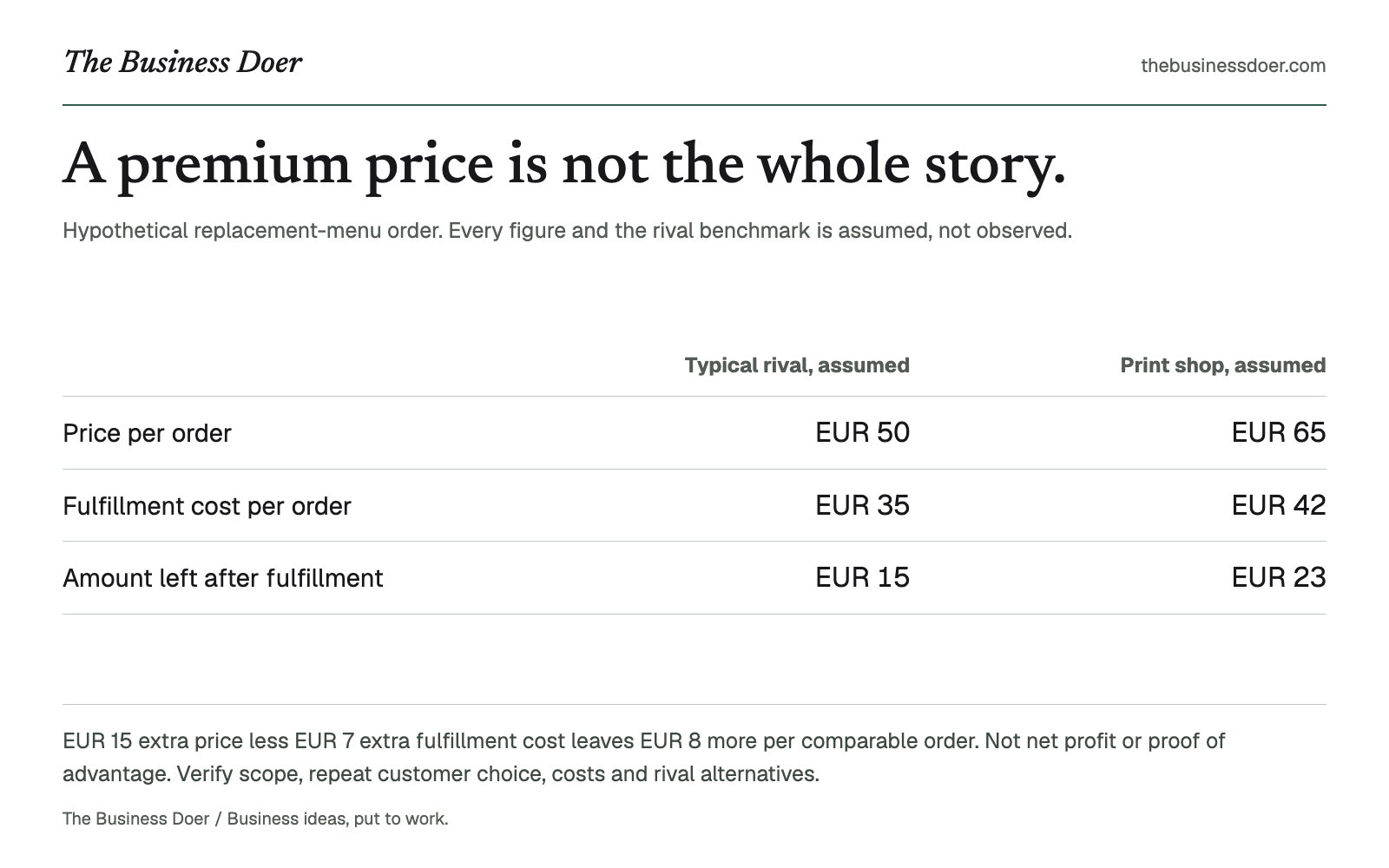
Visual reference. EUR 15 extra price less EUR 7 extra fulfillment cost leaves EUR 8 more per comparable order. Not net profit or proof of advantage. Verify scope, repeat customer choice, costs and rival alternatives.
Text version
Hypothetical replacement-menu order. Every figure and the rival benchmark is assumed, not observed.
- Price per order
- Typical rival, assumed: EUR 50; Print shop, assumed: EUR 65
- Fulfillment cost per order
- Typical rival, assumed: EUR 35; Print shop, assumed: EUR 42
- Amount left after fulfillment
- Typical rival, assumed: EUR 15; Print shop, assumed: EUR 23
Why does it matter?
Competitive advantage gives strategy a practical purpose. It helps leaders decide which customers to prioritize, which activities deserve investment and which requests or opportunities do not fit the chosen position.
Without a clear advantage, a business may copy competitors, add features without increasing customer value or compete mainly through discounts. An advantage claim provides a testable reason why customers should choose the business and why serving them can be worthwhile.
How does it work?
There are two basic economic routes:
- Lower relative cost: performing the activities needed to serve customers at a lower total cost than rivals while maintaining acceptable value. A low selling price alone does not prove a low-cost position.
- Differentiation: delivering distinctive value that makes chosen customers more willing to buy, remain loyal or pay a premium. Extra value must justify the extra cost of delivering it.
A focused business applies a route to a narrower customer group, geography or use case. Focus is the scope of the strategy, not a third automatic source of economic value.
The source lies in activities and capabilities. Purchasing, production, delivery, service, design and sales can lower cost or raise customer value. Value Chain Analysis helps locate those activities. The VRIO Framework examines whether a specific resource or capability may support an advantage. Core Competencies examines learned capabilities that can create meaningful customer benefits across products or markets.
Activities must also fit together. A fast-delivery promise is stronger when ordering, staffing, inventory and transport all support it. A connected system can be harder to copy than one visible feature; do not assume that it is impossible to imitate.
Customer behavior, realized prices, costs, retention and margins should support the claim. Until there is credible comparative evidence, the advantage is a hypothesis.
A simple example
Hypothetical example: A small print shop serves local restaurants that sometimes need replacement menus within 24 hours. Every figure and the rival benchmark below is invented for teaching, not researched competitor data.

AI-generated illustrative photograph. It does not document a real company, a 24-hour deadline, customer choices or observed sales performance.
| Measure per order | Typical rival, assumed | Print shop, assumed |
|---|---|---|
| Realized price | EUR 50 | EUR 65 |
| Cost to fulfill | EUR 35 | EUR 42 |
| Amount left after fulfillment cost | EUR 15 | EUR 23 |
The print shop charges EUR 15 more and spends EUR 7 more to fulfill the urgent order. EUR 65 − EUR 42 = EUR 23, versus EUR 50 − EUR 35 = EUR 15 for the illustrative rival. The amount left is EUR 8 higher per order under these assumptions.
Compare the same menu quantity, specification, service scope and tax basis. State exactly what fulfillment includes. This remainder is not net profit: other business expenses, capacity commitments and risks still matter. It is not a fully defined contribution margin unless all relevant variable costs are included consistently.
The example suggests a potential differentiation advantage if restaurants repeatedly choose the faster service, the shop meets the deadline, the costs are accurate and relevant rivals cannot easily match the offer. One order and an assumed rival cost are not enough. Track repeat purchases, on-time delivery, complaints and the amount retained across comparable orders, with sources and dates.
When should you use it?
Examine competitive advantage when defining strategy, entering a market, choosing target customers, reviewing positioning or deciding where to invest limited resources.
When performance weakens, ask whether needs changed, rivals copied the offer, costs rose or supporting activities stopped working together. Revisit the analysis after material customer or market changes.
How should you interpret the result?
A claim is stronger when it answers four questions with evidence:
- Which customers and alternatives are being compared? Include substitutes customers could actually choose, not only firms with the same industry label.
- What valued difference or cost difference exists? Distinguish willingness to pay or actual choice from an internal opinion.
- Which activities or capabilities create it? Explain the mechanism, not just the outcome.
- What results show that the difference is repeatable? Keep the period, scope, data source and uncertainty visible.
Lower cost without acceptable customer value is not useful. Distinctive value without enough revenue or margin may not be attractive. A strong result needs both a customer reason to choose and a business reason the choice is worthwhile.
Sustainable does not mean permanent. It means the advantage is sufficiently difficult to copy or replace that it can persist while relevant conditions hold. State its market scope and review period; a current advantage can weaken.
Common confusion
Advantage versus a strength. A strength is something the business does well. It becomes an advantage only when it creates valuable relative performance in a defined competitive setting.
Advantage versus a unique selling proposition. A USP is a message about why customers should choose an offer. Competitive advantage is the underlying ability to deliver superior value or lower relative cost. A memorable claim may be neither true nor defensible.
Advantage versus operational effectiveness. Better execution is necessary, but common best practices can be copied. Advantage depends on a distinctive position or system of activities, not improvement alone.
Advantage versus market share. Market share is an outcome measure. A high share may reflect an advantage, but also discounts, distribution, timing or past success. It does not establish the source or profitability by itself.
Industry structure also affects profit potential. That industry-level question is different from explaining why one firm performs differently from its relevant rivals.
Common mistakes
- Calling every strength or feature an advantage without comparing alternatives.
- Defining the market so broadly that customers and rivals become unclear.
- Assuming a lower price proves lower cost.
- Relying on one visible feature while ignoring the activities needed to deliver it.
- Declaring an advantage sustainable without evidence about imitation, substitution or change.
Limitations
Competitive advantage is relative, contextual and time-bound. It has no universal score, and reliable rival cost or customer data may be unavailable. Market evidence, financial evidence and repeated observation are still required. Unknown data should remain unknown, not become a convenient benchmark.
Quick checklist
- Have we named the target customer and relevant alternatives?
- Does the proposed edge lower relative cost, raise customer value or do both?
- Can we identify the activities and capabilities that create it?
- Do customer behavior and financial results support the claim?
- How could rivals copy it or customers replace it?
- Have we recorded the market scope, evidence gaps and review date?
Put it to work
Run a 25-minute competitive advantage check for one offer and one customer group:
- Minutes 0–5: Define the comparison. Name the customer, need and up to three realistic alternatives.
- Minutes 5–10: State the proposed edge. Finish: “For this customer, we create more value than these alternatives because…”
- Minutes 10–17: Identify the source. Record three activities or capabilities and whether each lowers cost, raises customer value or supports both.
- Minutes 17–22: Find evidence. Record one customer measure and one financial measure, including sources, dates and what remains assumed.
- Minutes 22–25: Set the next check. Choose a review date and the change that would make you reconsider the claim.
If the comparison, source or evidence is missing, keep the advantage unproven and identify the next fact to collect. Completing the worksheet is not proof; it produces a working hypothesis, not an automated strategy score or investment recommendation.
Keep observations separate from assumptions. This remains a working hypothesis; filling every field does not establish an advantage or produce a recommendation.
Key takeaways
- Advantage is relative to specific customers, alternatives and conditions.
- Lower relative cost and distinctive value are the basic economic routes.
- Activities and capabilities create the proposed edge; a feature or slogan does not prove it.
- Repeated customer and financial evidence should support the claim.
- A current advantage can weaken, so review it over time.
Final takeaway
Competitive advantage explains why a business can outperform relevant rivals for chosen customers through lower relative cost, distinctive value or both.
Treat it as a claim to test: define the comparison, identify the source and look for repeatable customer and financial evidence.